Ron, "Cove3", outlining the key factors of the strategic war between Intel and AMD.
Tuesday, January 30, 2007


Friday, January 26, 2007
The 72 Rule
The "72 Rule" allows to approximate the number of periods an investment takes to double the capital with a calculation so simple that you can do it in your head without calculator, and especially without exponentials or logarithms.
This article was inspired by this fragment of a "Fools" analysis, as far as I know this approach is original.
What is it?: If X is the return of an investment expressed in percents, then the number of periods it takes to double the capital is 72/X. For example, if you have a "long" position in an index that averages 7.2% returns per year, then it would take 72/7.2 = 10 years to double your money.
Is it a good approximation? Let's check it with the example.
If the average return is 7.2% per year, then after a year the investment becomes 1.072 what it was. After two years, it is 1.072*1.072 = 1.149184 the initial amount. After 10 years, it would be 1.07210 » 2.0042. So, the approximation wasn't that bad, 10 periods gives a growth very close to exactly double. Conversely, the exact answer would be Log1.072»9.97. In this case the rule gave an approximation within 0.3% of the correct answer.
The problem to calculate the logarithm in the appropriate base is that only scientific calculators have logarithms at all, and it takes too many repeated multiplications to come to an approximation.
Now, let us see how good the approximation is, and how to find an equivalent rule for other objectives, such as thrice the initial investment or 1.5.
Warning: Math comes ahead.
F is the multiplicative factor per period, from the percentage X, it is simply (X/100)+1
The "72 Rule" asserts that F0.72/(F - 1) » 2 ==>
(2Log2 F)0.72/(F - 1) » 2 ==> (Taking logarithm base 2)
Log2 F * 0.72 / (F - 1) » 1
Let us suppose both sides are equal and try to calculate the specific F for which the rule will work exactly, then:
Log2 F = (F - 1)/0.72
This equation holds if F = 1, but reveals what is the trick for values close to 1: To approximate the logarithm base 2 of F with a straight line. Let's see how close that line resembles the log2:

the approximation is good because the line has about the same slope of the logarithm at X = 1 (derivative of Log2(X) = 1/(X*Ln(2)), when X = 1, that becomes 1/ln(2) » 1.44, close enough to 1/0.72 » 1.39. Interestingly enough, they are different!
Let us recapitulate: So far, we could have used any number not 72 to try the same approximation and the logarithm base 2 would have coincided with the straight line at X = 1, but the resulting line wouldn't have been close to the logarithm. By the way, the constant which leads to the tangent at X = 1 would be Ln 2, about 0.69. Thus, if you feel like it, speak of the "69 Rule".
Now, this is a bit of "hairsplitting" because minute variations in the slope of the approximating line become even minuter with small variations around 1, but for curiosity let's see where the 72 leads us:
The slope coincides when
1/(X*Ln(2) = 1/0.72 ==> X = 0.72/Ln(2) » 1.03874.
And Log21.03874 » 0.0548 and (X - 1)/0.72 » 0.0538
We have:
1) Both approximation and log are equal at X = 1
2) The slope on the log was about 1/0.69 > 1/0.72, thus the log grows "faster" at X = 1
3) by X = 1.03874 the log is still above the line but has the same slope
4) We know that the log slope is going to go down, then the curve will bend lower
==>
a) The log will cross again the line.
b) This point (X = 1.03874) is the maximum error in the approximation
This is the moment when you can use your numerical method of choice. I will use a simple graph that says that such thing happens at about 1.078 (no surprise that it is about as far to 1.03874, the max error point, as the max error is to the other solution to the equation, X = 1).
==>
c) This rule works best between 5% and 9%
A bit of worst case: let's say that the returns are 3.9%, the rule says that it takes 72/3.9 periods to double the capital, or 18.46 periods. The Log1.0392 » 18.11, still close enough for practical purposes.
Now you have it, if you want, let's say, to approx the moment of tripling the investment, you can refine this argument and consider that a 100*Ln 3 rule wouldn't be as good as a rule that has an slightly lower slope (higher number of the rule), and you can use the fraction 0.72/0.69 as a guide (115?).
2.3% per period would triple the investment at 115/2.3 = 50 periods according to the "115 Rule" (the correct answer is slightly more than 48.3, 50 is not a bad approx...)
Another consequence of this analysis is that you can use 70 rather than 72 for very small percentages because if you remember, 69 was the slope at 1, thus, for F values much closer to one, 69 is better than 72, but 70 is even easier to remember. For percentages such as monthly returns... Let's say you have 1% per month, the "70 Rule" approximates the number of months to 70. The Log1.012 is 69.66 something, awesome, right?
This article was inspired by this fragment of a "Fools" analysis, as far as I know this approach is original.
What is it?: If X is the return of an investment expressed in percents, then the number of periods it takes to double the capital is 72/X. For example, if you have a "long" position in an index that averages 7.2% returns per year, then it would take 72/7.2 = 10 years to double your money.
Is it a good approximation? Let's check it with the example.
If the average return is 7.2% per year, then after a year the investment becomes 1.072 what it was. After two years, it is 1.072*1.072 = 1.149184 the initial amount. After 10 years, it would be 1.07210 » 2.0042. So, the approximation wasn't that bad, 10 periods gives a growth very close to exactly double. Conversely, the exact answer would be Log1.072»9.97. In this case the rule gave an approximation within 0.3% of the correct answer.
The problem to calculate the logarithm in the appropriate base is that only scientific calculators have logarithms at all, and it takes too many repeated multiplications to come to an approximation.
Now, let us see how good the approximation is, and how to find an equivalent rule for other objectives, such as thrice the initial investment or 1.5.
Warning: Math comes ahead.
F is the multiplicative factor per period, from the percentage X, it is simply (X/100)+1
The "72 Rule" asserts that F0.72/(F - 1) » 2 ==>
(2Log2 F)0.72/(F - 1) » 2 ==> (Taking logarithm base 2)
Log2 F * 0.72 / (F - 1) » 1
Let us suppose both sides are equal and try to calculate the specific F for which the rule will work exactly, then:
Log2 F = (F - 1)/0.72
This equation holds if F = 1, but reveals what is the trick for values close to 1: To approximate the logarithm base 2 of F with a straight line. Let's see how close that line resembles the log2:

the approximation is good because the line has about the same slope of the logarithm at X = 1 (derivative of Log2(X) = 1/(X*Ln(2)), when X = 1, that becomes 1/ln(2) » 1.44, close enough to 1/0.72 » 1.39. Interestingly enough, they are different!
Let us recapitulate: So far, we could have used any number not 72 to try the same approximation and the logarithm base 2 would have coincided with the straight line at X = 1, but the resulting line wouldn't have been close to the logarithm. By the way, the constant which leads to the tangent at X = 1 would be Ln 2, about 0.69. Thus, if you feel like it, speak of the "69 Rule".
Now, this is a bit of "hairsplitting" because minute variations in the slope of the approximating line become even minuter with small variations around 1, but for curiosity let's see where the 72 leads us:
The slope coincides when
1/(X*Ln(2) = 1/0.72 ==> X = 0.72/Ln(2) » 1.03874.
And Log21.03874 » 0.0548 and (X - 1)/0.72 » 0.0538
We have:
1) Both approximation and log are equal at X = 1
2) The slope on the log was about 1/0.69 > 1/0.72, thus the log grows "faster" at X = 1
3) by X = 1.03874 the log is still above the line but has the same slope
4) We know that the log slope is going to go down, then the curve will bend lower
==>
a) The log will cross again the line.
b) This point (X = 1.03874) is the maximum error in the approximation
This is the moment when you can use your numerical method of choice. I will use a simple graph that says that such thing happens at about 1.078 (no surprise that it is about as far to 1.03874, the max error point, as the max error is to the other solution to the equation, X = 1).
==>
c) This rule works best between 5% and 9%
A bit of worst case: let's say that the returns are 3.9%, the rule says that it takes 72/3.9 periods to double the capital, or 18.46 periods. The Log1.0392 » 18.11, still close enough for practical purposes.
Now you have it, if you want, let's say, to approx the moment of tripling the investment, you can refine this argument and consider that a 100*Ln 3 rule wouldn't be as good as a rule that has an slightly lower slope (higher number of the rule), and you can use the fraction 0.72/0.69 as a guide (115?).
2.3% per period would triple the investment at 115/2.3 = 50 periods according to the "115 Rule" (the correct answer is slightly more than 48.3, 50 is not a bad approx...)
Another consequence of this analysis is that you can use 70 rather than 72 for very small percentages because if you remember, 69 was the slope at 1, thus, for F values much closer to one, 69 is better than 72, but 70 is even easier to remember. For percentages such as monthly returns... Let's say you have 1% per month, the "70 Rule" approximates the number of months to 70. The Log1.012 is 69.66 something, awesome, right?
Saturday, January 20, 2007
The Sandwich
Thanks to Tom's Hardware Guide for this magnificent updated graph: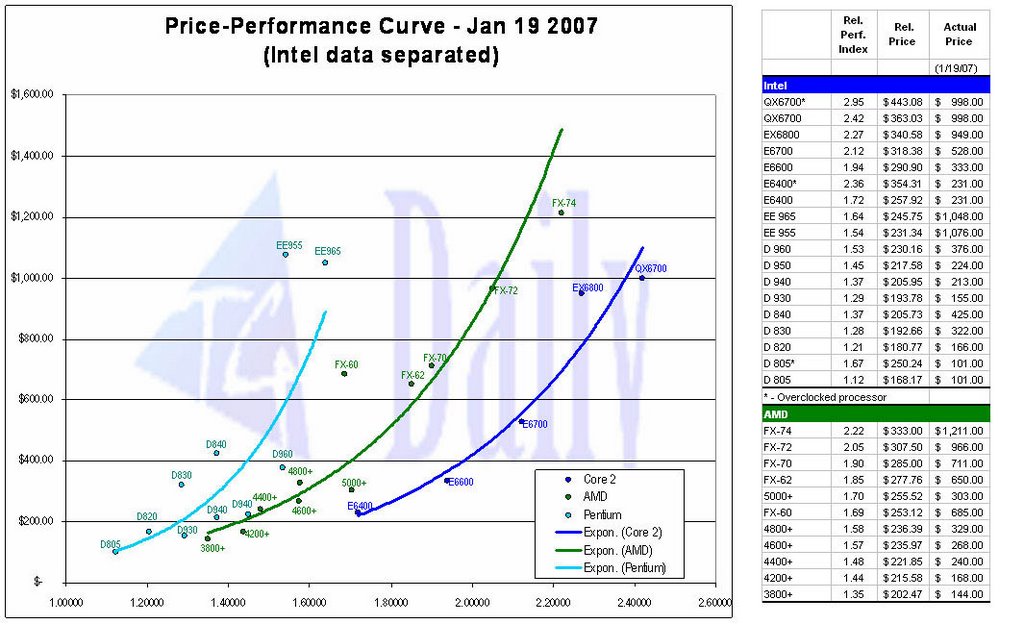
This graphic has some controversy about the performance measurements, but for the most part, the trends are there. Yes, I have come to validate the notion that Core 2 Duos are quite simply superior to anything AMD produces, with the only possible exception of the entry level dual cores 3600+ X2 at 65nm which is "Energy Efficient" and the 3800+ X2 because they have better performance/(power*price).
In this graphic you can not completely see how bad the Pentium processors are, because their inefficient power consumption is not part of the performance data.
But in any case, you may see here that the only competitively priced AMD processor is the 5000+ X2, and that barely.
Although the gist of the article in which this graphic appears is that AMD is raising its prices, you can see that such initiative wouldn't fly much. Whoever has the money to buy products mentioned in this chart goes to sites like THG for guidance, and the community of benchmarkers pretty much agree with THG, furthermore, Core 2 Duos have positive rapport among customers.
Perhaps AMD is relenting in its insistence to win market share. We have seen this year how inelastic the demand for processors is, thus, there is simply more money to be made raising the prices, if the market share losses are moderate. Why would AMD do that? because it needs money, perhaps to compensate for the huge ATI losses that must be occurring now. If AMD keeps being optimistic about ATI they may say that right now it is more important to have better cash flows than to gain market share, so that the company may finance the projects that will enable better products to make another market share win charge.
Continuing with "AMD's long year", I said that "AMD is losing lots of revenue share between the ceiling that superior Intel products impose and over the quicksand created by millions upon millions of netbusteds" are being dumped, that is the sandwich that this graphic illustrates.
Inelastic: Let us suppose that you have a retail store and product X costs almost nothing to you. You obviously want to make the most money with X, either selling small numbers at a high price, large numbers at low price, or something in between. The answer depends on the demand elasticity of X. If you lower the price of X 1% and that stimulates demand to raise 1% then X would be said to have 1 of demand elasticity coefficient. If you lower X price 1% but see that demands increases 2%, then you would try to lower the price as much as possible because the increase in demand is overcompensated by what you are not receiving in price per unit. If you lower prices 2% but only see 1% inrease in demand, then X is called "inelastic". In this case, you win more money if you raise prices as much as you can. The problem with raising prices, naturally, is that your customers go to your competition. The market share shifting tells you how far you can go.
Wednesday, January 17, 2007
A long year for AMD
AMD couldn't make it this quarter, which is the most important in the year, because it grew revenues merely 3% sequentially while Intel grew 8% when usually the jump due to the holiday season is more than 10%.
I am very surprised that AMD said that it blew the most important quarter in what profiles to be a horrible year and the beating didn't go much further than $18, furthermore there was AMD trading upwards of 110 million shares, the most ever. The ~$17.95 price level of that day constitutes hard support with the information we know, but there remains important incognitas to be cleared, thus $18 may seem a good price to short-sell AMD after all (1).
This is what happens:
There were high hopes for a Vista-induced recovery early in the year, but the cards have been dealt and we know that is not happening, only a slow improvement in demand. This is important also because the digital TV side was the part that could have benefited most.
Anyway, this year is going to be governed by the issues raised at the ATI purchase, thus I will begin the analysis there.
ATI as a standalone company was valued at X because it was a business capable of generating Y revenues and Z profits(/losses). What is valuable about ATI isn't their offices or inventories of product, but the designs that may be turned into products, the established distribution channels, the experience to deal with the technology issues, and so on. I would call this the ATI "softcapital".
To purchase ATI, AMD had to pay the usual 20% premium that happens in these cases. Nevertheless, inside AMD, ATI is not a business capable of Y revenues nor Z profits, but, for simplicity's sake, Y/2 revenues and substantial losses; because more than half of the market for ATI products are Intel based computers that won't exists because Intel and ATI won't cooperate further to integrate their designs, and Intel will give preferential treatment to nVidia, which is the graphics technology leader, anyway. Thus, by just purchasing ATI, AMD devalued it significantly, let's say to a half. Then, AMD paid 120% for a business that inside it is worth half... 240% of what the market values that business. You may disagree with these numbers, but that is not important, what is important is that inside AMD, ATI is worth much less than standalone. This should have been a decisive deterrent for a purchase, but nevertheless, AMD went ahead with it.
Did AMD have projects to invest in? Yes, it has: A New York Fab, more production facilities at Dresden, and conversion of Fab30.
Isn't another loss the forced allienation of nVidia, whoose 3d graphics designs are superior to ATI's and also has a quite competitive business in chipsets?
On the other hand, AMD has still to pay huge charges due to the restructuring of the resulting company and to service the huge debt it incurred to purchase ATI. This means that just to break even, AMD must find not just synergies and leveraging opportunities for the ATI side of the business that may compensate the acquisition related charges and its debt financing, but also the devaluation of the ATI business, the missed benefits of other projects, and the cooling down of partnerships with nVidia.
Thanks to this approach I finally got to a definitive conclusion: Purchasing ATI was a blunder.
If it was going to devalue ATI so much, I would have preferred to go on the slow (but sure) path of partnership to develop Fusion and other initiatives. My opinion is that an ATI purchase was not a requisite for a 2009 schedule of MCM processors with graphic capabilities (fusion), and this approach had the important benefit of being able to invite nVidia in. Instead, AMD changed its focus from enthusing the partners about more accessible short-medium term initiatives such as Torrenza graphics and physics coprocessors for a very distant fusion initiative, leaving orphaned initiatives such as 4x4 that without coprocessors seem ill-conceived (2).
Those $500 million acquisition related charges translates to about $0.9 per share, that is, they wipe out the prognosticated earnings of a whole year!.
The only initiatives that AMD is pursuing are production capacity expansion and fusion. But we know that the market already has plenty of production capacity, that AMD really doesn't have competitive advantages here; and we know that fusion is very far and may become an irrelevant success if AMD loses continously revenue share, market share, and mindshare for the next two years, just as AMD64 was an out-of-this-world advantage that could only be made use of to penetrate a rather small portion of the server market before Intel, for all practical purposes, catched up.
And AMD is losing lots of revenue share between the ceiling that superior Intel products impose and over the quicksand created by millions upon millions of netbusteds.
There could be hope if the introduction of the 65nm processors would have shown 1) A truly mature process, 2) Performance advantages. Nevertheless, the current 65nm shrink effectively turned out equivalent to a 75nm shrink without performance advantages, rather, minor performance disadvantages, only improved power efficiency. This is every bit as worrysome as the faith some AMD bulls have in the quadcores, because the exponential nature of the worsening of yields mean that there is no chance for AMD to produce single die quadcores if its yields are not fantastic ~95% in equivalent single cores, and not having been able to shrink to sub-70nm effective feature sizes mean that the process is not mature, and it is becoming late in the game for the quaddies when Intel's double duals are already performing well in the market and by the time AMD manages to introduce them Intel may be on the market with 45nm products.
Thus, we may conclude that ATI will "provide" losses rather than synergies to compensate for the huge financial and other kinds of burdens it is imposing on AMD, while Intel is swamping the market with superior products and firesaling netbusteds; and there is the possibility that AMD is stalling at 65nm inducing delays in quadcores, the only products of interest in its roadmap.
Notes:
1)I am not advocating to short sell AMD, just explaining that the the price may crash despite the huge trading that happened at the upper $17 level
2)The difference between a dual socket workstation/server and a dual socket gaming computer is small: The server requires higher reliability and expandability, hence the registered dimms, but the gaming station may work with the cheapest hardware available, hence the unbuffered dimms. The other part of 4x4 is to have huge I/O capabilities, but not for network or storage as a server, but for graphics. That's why it is to be expected that 4x4 motherboards will have double everything. In the 4x4 architecture, only one of the sockets has access to I/O, which bears the quesiton why: That way the computer may work with only one processor. This bears another question: If one processor is enough for the huge graphic I/O of 4x4, then what is the point of the dual socket? -- Artificial Intelligence, Physics, or Graphics coprocessors!. In the absence of coprocessors, all you can do is to put another processor, further erasing differences with a workstation. That's why 4x4 seems so silly.
Thursday, December 28, 2006
More than 4Gb Windows and XP x64
Finally there are memory modules and kits that allow you to get past the 4Gb barrier.
In newegg you find G. Skill DDR2-800 dual channel (128 bits) 4Gb memory kit (2x2), allowing you to install up to 8Gb. Sad that the product is CAS-6, rather slow taking into account that newest DDR2 -800 modules come CAS-4. -- UPDATE (JAN - 25) There are CAS-5 modules available, Geil and GSkill brands, also in newegg.
What would you do with a computer with more than 4Gb of RAM?
I was so attentive to when the 2Gb memories were going to hit the market because I do "megatasking" routinely having so many virtual machines running simultaneously, and inside them I do everything from transcoding video to web serving.
But if you are currently a content Windows user at more usual RAM capacities, then more than 4Gb won't give you much extra satisfaction.
No windows version of 32 bits can really make use of all of that RAM memory without incurring in nasty compromises, thus you must use a 64 bit Windows. But then the problem is that none of the 64 bit variants (there are only XP x64, 2003 x64 and Vista x64) are compelling operating systems.
I am writing from XP x64 Professional and 2003 x64 is very similar thus my experience applies to both:
XP was always assumed to be a 32 bit O.S. by everybody from hardware manufacturers to software developers (including malware crackers), and being Windows what it is, tolerated harmful practices that hardened the task of updating the O.S. without breaking compatibility with multitude of devices and applications.
Nevertheless, Microsoft did a good job wrapping up the 32 bit API in WoW (Windows over Windows) to allow AMD64 long mode of operation while offering compatibility for old applications. Thanks to this design success, it is possible to make use of the benefits of AMD64 to compensate for the other defficiencies of XP x64, but users must be aware of the trade-offs involved and personally, I am moving away from it because I don't find enough compensation.
In summary, AMD64 long mode allows Windows compatibility for applications but not for drivers and doesn't allow hybrid 32/64 applications/dlls.
Although the 64 bit interfaces in Windows are good, the applications world was already too set up in the 32 bit ways to make the change and that forces users to stick to the 32 bits. Then, in XP x64 there is the constant fight between the old applications and the enhanced features:
You have Internet Explorer as an uncontaminated (comparatively) 64 bit application, but not even Windows Update would use it, Windows Update sticks to the dreadful 32 bits version. Why? because the ActiveX controls on which Windows Update is dependant assume 32 bits. The same thing with all the nice features that you can put to an Internet Explorer.
Mozilla/Firefox? The Mozilla foundation hasn't even bothered to port to 64 bits. Cygwin? the same.
Java? I had a horrible experience trying to make the programs I wanted to use 64 bits Java because most of the applications, being 32 bits, assumed it and interfaced through DLLs that were incompatible. In general, it became a mess of which Java Runtime was going to get executed for real.
Development? Visual C++ Express 2005 supports x64 only through multiple workarounds.
Since x64 also requires special drivers that are uneconomical for device manufacturers to provide, the hardware support for x64 leaves too much to be desired.
Since it is difficult "right off the bat" to develop for x64, it is lagging behind.
Since it is lagging behind it is unpopular among the enthusiasts/power users who want to be on the edge. Since it doesn't have the support of that important market segment, then it is uneconomical to support it, closing the vicious cycle.
I lost enthusiasm about XP x64 because the harware and software support for XP x64 hasn't really improved from the times when I started to use it; what you get are undertested, old, unsupported drivers and applications; the community of users, although much better in knowledge per person than other communities is so small that in no way we compensate for our tiny numbers, there isn't much mutual help. And to top that off, my appreciation, after one year of usage, is that the community has been shrinking because its constituency of early adopters (such as myself, to a degree) who expected XP x64 to migrate toward mainstream have been continually dissapointed and have seen that it was passed over by Vista.
Then, there is Vista x64, which like any Vista version is a completely unacceptable Operating Systems for many reasons, most prominently being a TOTALITARIAN Operating System that the owner (actually licensee) doesn't control and in which Microsoft may decide regardless of the computer owner what the computer should or shouldn't do, for instance, to not play HD video or to deactivate a device because it is not complying to Microsoft's orders (again, regardless of the owner/licensee); that the O.S. consumes resources like crazy to purposedly obstruct the user to do things that potentially may collide with the interests of Microsoft, or in the best of cases to provide him/her with irrelevant graphics. There will be posts detailing how Vista is unacceptable.
In conclusion, the large memory modules which could make one of the most important advantages of XP x64 (and AMD64) to shine, came to the market so late that made them a moot point.
Friday, December 22, 2006
This blog is alive and kicking
Highly regarded audience, this blog continues to be an active project, the interruption of the flow of articles was due to my insatisfaction with the style in which I was writing. There are also personal reasons (for instance, I got married), I also lost clarity about AMD because I don't fully understand what I want of the implications of the ATI purchase.
Fortunately, I have fresh ideas to write about that will be coming.
Saturday, November 11, 2006
100% growth in one year
in the supercomputers market share for AMD opterons. It was 11% one year ago, now it is 22%. Not bad. Will the trend continue?, yes I think it will, perhaps at the same rate!
I took the information from here.
Why is this happening?
Because the interprocessor communication links that Opterons have, based on ccHTT (Cache Coherent HyperTransport Technology), scale nearly linearly, allow multiple processors to have their own memory that is shared to any other processor by direct links.
Intel's bus technology is hopeless.
But these things have a dinamics of their own, with the presumed superior Woodcrests, and the upcoming clovertowns, this is the chance for the Intel lovers to sneak some systems into the top supercomputers list.
Monday, October 30, 2006
The mistery of AMD's 117% institutional ownership
A fellow in the message board detected that AMD had 118.8% institutional ownership the day he posted. That number would mean that institutions own all AMD's float and then some 19% more, clearly absurd.
Thus, what is the nature of the error?
A typo? No, because the data for today indicates a different number (117% today) that is changing by the day.
Is the Nasdaq web page doing something goofy such as combining all of ATI (ATYT) institutional holdings with AMD's?... perhaps.
But I suggested that this number may come from naked shorting: AMD's institutional ownership had always been very high (eighty-percentish), to begin with, and it may have happened that the institutional investors actually liked the earnings report (due to increased profits, revenue share, and even gross margins higher than historical and above Intel's while growing in the hottest segment, mobile) and decided not to sell but to buy while "the market" was crazy selling AMD as if it was going to bankruptcy, trading extraordinarily high volumes (about 20% of the float every day for a week), suggesting that the volume and the price slide came from inexistent shares, that is, the result of naked shorting, and in the face of this flooding of cheap AMD "shares", some institutions bought some more taking their percentage above 100%...
Naked Shorting, means shares that were sold short without being borrowed first. A quick explanation: when someone sells short, in theory that someone borrows the shares to sell them at market price, if the shares go down in price, then the liability is smaller and the short seller keeps the difference. The brokerages do the borrowing part, meaning that they must locate who to borrow the shares from. What if there is no borrowing, that a brokerage just takes the money and delivers a temporary certificate for the shares? This scenario is covered by an excellent presentation by Patrick Byrne, the C.E.O. of Overstock.com: It seems that the S.E.C. is so weak that the brokerage/dealers may sell short without any borrowing, flooding the market with pseudo shares and thus forcing the price of the shares down, while the pseudo shares may linger FOR MONTHS AND YEARS without being cleared out of the system. On top of that, there is no official data to prove Byrne wrong, that's the point: There is the problem of brokerages that fail to deliver the real shares to whoever bought them and there is no way to find out the extent of the problem.
It is good that even "Syndrome" agreed with my suspicions and cited the same links I provided even though, as it is typical in him, "forgetting" to indicate who had the original idea.
I am not knowledgeable about how the Nasdaq calculates its numbers, I would like to know what is the matter.
Tuesday, October 24, 2006
AMD keeps gaining revenue share
I was saving a little research work I did for the times when the Mercury Research report about AMD's market share were made public.
I am comparing AMD's revenues, which are now almost totally composed of microprocessors to Intel's revenues associated with µ . I am using the data available from both companies financial results. There is one issue with Intel's operating income: It includes the incomes derived from chipsets, that's why the numbers for AMD in the operating income share are much lower.
All in all, AMD is managing to keep the lead in the struggle: It is well known that its gross margins have been above Intel's for the last two quarters, it is extraordinary to see how it is also grabbing bits of revenue market share despite the onslaught of Netburst dumping and CMW ramping.
| Q3 / 06 | Q2 / 06 | Q1 / 06 | Q4 / 05 | Q3 / 05 | Q2 / 05 | Q1 / 05 | |||
| Intel | Digital Enterprise Group | Microprocessor | 3521 | 3338 | 3892 | 4929 | 4936 | 4603 | 4944 |
| Chipset | 1425 | 1283 | 1255 | 1476 | 1434 | 1398 | 1417 | ||
| Net Revenue | 4946 | 4621 | 5147 | 6405 | 6370 | 6001 | 6361 | ||
| Operating Income | 858 | 931 | 1360 | 2448 | 2164 | 2016 | 2383 | ||
| Mobility Group | Microprocessor | 2239 | 1958 | 2347 | 2400 | 2331 | 2056 | 1917 | |
| Chipset | 809 | 731 | 632 | 705 | 639 | 566 | 517 | ||
| Net Revenue | 3048 | 2689 | 2979 | 3105 | 2970 | 2622 | 2434 | ||
| Operating Income | 1260 | 946 | 1155 | 1547 | 1431 | 1220 | 1131 | ||
| Total Revenue microprocessors | 5760 | 5296 | 6239 | 7329 | 7267 | 6659 | 6861 | ||
| Op. Income (includes Chipsets) | 2118 | 1877 | 2515 | 3995 | 3595 | 3236 | 3514 | ||
| AMD | Net Sales | 1327.6 | 1216.4 | 1332.2 | 1351 | 1007 | 797 | 780 | |
| Operating Income | 119.2 | 102.1 | 258.6 | 268 | 129 | 83 | 64 | ||
| Net Income | 134.455 | 88.847 | 184.52 | ||||||
| AMD Revenue share | 18.73% | 18.68% | 17.60% | 15.56% | 12.17% | 10.69% | 10.21% | ||
| AMD Operating Income Share | (This includes Intel's chipsets) | 5.33% | 5.16% | 9.32% | 6.29% | 3.46% | 2.50% | 1.79% |
Monday, October 23, 2006
Options are cool — dedicated to Ron (Cove3)
Someone from the AMD message board whom I have learned to respect, Ron (Cove3) has criticized the existence of options and other ways to leverage investments, such as margin, because that infuses volatility on markets and become instruments of stock price manipulation. Since he is opposed to options in general, he also dislikes discussions in the message board about their usage. This friend is the one I have quoted most often in "the best message board posts" thread I (somewhat) maintain thanks to his excellent analysis.
But it happens that I strongly disagree with such negative notions about options and this post is an explanation of my reasons. This is very long, but one of my best essays ever as far as content is concerned... about the language... well, I also wrote in a rush.
To begin, let us not talk about equity options, let us talk about real estate investments.
Would you buy a house and not have it insured against a disaster? Perhaps you would prefer not to insure it, but I guess that you agree that insurance is a justifiable idea for investments that took probably decades for a family to acquire. Well, put options (options to sell) are precisely that: insurance for equity investments. Having insurance facilitates to some investors to put their money in those stocks, because through the combination of the shares and puts in the same amount (so called "married puts"), the investor guarantees a risk exposure of his choosing. Just like insurance, the higher the risks of a tragedy to happen, the higher the premiums. It is only reasonable.
On the other hand, is there a way to motivate employees, and especially upper management to collaborate with the well being of the company in a way that shareholders benefit? It may be not effective to stimulate them with plain shares, the relationship of capital to returns is too small, there is the need for leverage. On the other hand, the time frame at which share price appreciates may be too long as to make it impractical. Again, leverage is needed. For upstart and technology companies, which require top human resources and move in a very volatile environment, probably the only way to align the employees with the interests of the shareholders are the options packages. I have worked in companies that got my services because they offered me a participation in the success of the company itself through options: If I accepted the risks of the projects I was working on because I believed in those projects, and the projects actually worked, then I would receive significant benefits, despite the fact that I wasn't someone who had money to financially support the company. And there frequently are rules such as that to be eligible for an options package, you must work for some months/years, effective factors to reduce the very high turnover rates in technology companies, which produces economic inefficiency at large scales.
Thus, both kinds of options, to sell and to buy, have benefits.
Have you ever learned about the history of maritime empires such as Holland and England? Think about the times when, let's say, England ships navigated to China to commerce and bring back important products, in voyages that took upwards of a year fraught with all kind of perils: One factor that helped make them practically viable, for the benefit of those economies, was the existence of insurance. I am not good at analyzing the finances of a company, but I claim to be a good technologist. I love the idea of investing in the companies that have technology leadership because I think that the leadership ends up showing up all over the market. But AMD in particular is very volatile because of intrinsic reasons (at the same time it has huge possibilities, but equally huge uncertainties about succeeding). Perhaps I wouldn't have the stomach to commit the savings of all my life to investing in this company. Diversification may not work for me either, because all I would be prepared to invest in are technology companies with the same volatility problem, and I would be vulnerable to problems in the sector. No, for people like me the insurance that put options provide may be the difference between investing or not.
Just like insurance was born out of necessity and as a consequence of the development of markets, financial derivative instruments such as options and futures were born.
Some people may object that they complicate things for everyone, but nobody has ever said that we have to refuse the benefits of the modern world because it is very complicated.
The same thing happens with options (and other financial derivatives, for that matter). To radically oppose them is more or less the same thing as banishing modern technology because it can be mis-used to catastrophic consequences.
More to the point, some people may argue that day trading should be prohibited because it (supposedly) doesn't benefit anybody, that short selling is prejudicial, in general, that speculation is negative.
Well, I disagree, let me explain each point separately:
All markets are less than perfect, and the distortions only create economic inefficiency, therefore, it is justified for an economy to expend some resources addressing this problem.
Let me tell you an anecdote:
While I was learning about options, I noticed that there were cases in which some options for some stocks were mispriced; for example, a call was unusually high priced (and/or the puts were too cheap), as if the investors were anticipating a jump in the stock price and were speculating with the options rather than the shares, which created an imbalance. Knowing that options are derivatives, and that there are equivalences between the shares, the puts, and the calls; if the calls were "expensive" I synthesized them with puts and shares and wrote the expensive calls keeping the difference in a risk free business. There wasn't much money to be made that way, because the distortions were minimal, and the companies small, thus by the mere fact of buying puts to synthesize calls I produced an effect of raising/lowering the prices of those options. Those opportunities existed because the big firms wouldn't care to commit their resources for such peanuts, but for me it was perfect to make a dime while learning. I actually made money that way. Was I contributing to the companies whose stock I was working on?: no. But I was contributing to this economy: I was devoting resources (entrepreneurial abilities, labor and capital) to make the stock market less imperfect.
By the same token, those who day trade help the markets to become more efficient.
What is the right price for, let's say, shares of AMD? Nobody knows. How do you get to a price, then? -- through the participation of traders. Ah!, but wait a minute, how reliable is the price that the market is assigning to AMD shares? again, nobody knows, but the standard deviation of the annualized lognormal variation (obtained through the market) gives you a good idea. If you want to have a developed market, for the economy's sake, you must understand that you have to pay for it. That is, you must allow people to benefit from their work coming up with an assessment of what the right prices are and what the right volatilities are. The best thing of the current state of affairs is that the risks of that activity are assumed by those working on it.
I expended years upon years studying sciences, including very sophisticated mathematics. Even though I currently am not doing something so called "productive" with all of that accumulated knowledge and skill, I don't see the efforts I am expending at trading the way I can and works for me as a waste of those "resources" under my control (my time, knowledge, skill and capital), quite the contrary, I have a very high concept of how they contribute.
Also, a necessary positive spillover of that activity (an economic "externality") is the creation and maintenance of this blog, which has an educational component, like our participation in the message board: You don't have to agree with me about my opinions, but perhaps our efforts in the intellectual exchange of ideas is productive, that is a net positive.
Going back about leveraging investments, although I have actually lost money so far, I still think I am capable of appropriately using margin to leverage my investments, especially in the recent months that I have been accelerating my gains. As a matter of fact, the margin leverage is what is making it worth for me to dedicate increasing efforts to the stock market, and increasing capital through informal agreements in my network of acquaintances.
Short selling? The only way to make it worth for people to "say" that a security is overvalued is to allow market participants to bet against a security (allowing them to benefit from detecting overpricing). According to Sharikou, the demise of Enron, which was arguably a good thing that if anything should have happened much sooner, began once investors who took bearish positions on Enron kept asking though questions and demanding answers. Of course, those who were under the delusion and had vested interests (quite literally) didn't want to uncover an scandal of this magnitude.
What I have been talking about doesn't mean that there is no chance for manipulation.
I said that just like technology, these financial instruments give the bad guys the power to do more harm. But it is difficult to qualify anybody in a stock market as a bad guy. I mean, let's say that you want to probe the degree of conviction that the market participants have about a given price level, then you use your money to try to induce movement in a determined direction. Is that illegal or immoral?
If the recent sell-off of AMD was provoked by "market manipulators" using God knows what kind of non-obvious mechanisms to induce panic selling, then the manipulators made me an important favor: They separated the shaft from the wheat. I mean it, because although I am "down" due to the sell-off, assuming the hypothesis of the manipulators, then my shares could be safely acquired at these price levels now that the manipulators got rid of the speculators looking for a quick profit, because I think that what separates an investor from mere speculators is that when the investor sees his investment at a lower price he would tend to buy because the same thing can be acquired for less, while the speculator will sell because the underlying is not moving according to his prediction.
In this whole quarter I bought at three occasions: 1) After there was panic selling regarding the ATI acquisition/bad quarter results, although a modest quantity, 2) After ATI warned, another small quantity, and 3) After the excellent quarterly reports last week (at least, they are still much better than what *I* expected, which is what counts), a very large amount this time. Do I expect the price to go up short term? No, not really. I didn't abstain to buy simply because I didn't have guarantees that these good prices were going to happen again, and these major shake-ups got rid of weak investors, diminishing volatility, thus I had enough protection already to enlarge my holdings.
But it may be the case that there are no manipulators, that the quarter results, in the form of the gross margin decline, reveals the tragedy of AMD that now has production capacity but is forced to sell at steep discounts because it no longer has competitive products.
About the manipulators, the case must yet be constructed: a) To indicate exactly what is the conspiracy, b) to explain why that conspiracy is immoral/illegal or harmful to the economy, c) to demonstrate that the manipulation mechanism works, d) to demonstrate that the market doesn't have preventive/corrective strategies against those manipulation mechanisms. So far, all I see is a bunch of disgruntled investors angry that their investments are "down".
I advised repeatedly about not being a "low hanging fruit" for those who were "shaking the tree" (I still think that this was Wall Street shaking the tree), perhaps the major firms had a tacit agreement that if there was any weakness in AMD's report it would be pointless to hold, that it would be easier and safer to just sell and buy back lower, especially if the players had the (correct) appreciation that the others were going to feel alike.
Going back to gambling with options, well, it is arguably something stupid and bad. Like drinking alcohol or playing the lottery. But it happens that some people actually like those activities, thus I don't have moral grounds to make them illicit. In the case of options gambling, it is more sort of gambling in the hippodrome, there are those who have so much dedication at horses that they can consistently beat the odds against them to make little gains, thus it is even harder to condemn the activity.
But that doesn't mean that we shouldn't try to educate our fellows, especially the newbies, that derivatives are dauntingly complex, and that they should be used with extreme care. That suggests that we most participate in constructive discussion about this subject.
My friend Asatru Skald, whom I feel honored to be qualified by him as his friend, and I have been working in a protective way to diminish the risk of investing in AMD. As a matter of fact, I am extremely enthusiastic because I think the mechanism works great (and has been working great indeed), it seems to pour money without real risks, thus it is natural to use the message board as forum; especially because our versions of the mechanism are full of interesting questions, such as: "Should I protect with far out of the money leaps puts, or ATM, or far in the money?", "Should I allow my written calls to be exercised?", "Should I make counter-momentum trades, or momentum-neutral?", "does it work unmodified in higher than normal volatility scenarios such as earnings reports?". I could expend the whole day interchanging ideas about these questions, and I think that my pretension would be entirely legitimate.
There are many factors coinciding to make the stock market more volatile, not just that since there are margin and options investors can do many more crazy gambles and introduce more noise to the environment: Time is compressing in this civilization, transformations happen much faster than ever before. It is not only a matter of having zillions of discount brokerage firms with zillions upon zillions of "investors" connected to the internet and chasing their securities in real time rather than the paucity of the old process of calling the broker to do the trades and get financial advise. A closer example: It took a mere few years, one could say months, for a company such as Youtube to go from being valued zero to more than a 1 G$, without it needing to even post a single dollar in profits, think about it, such quick "rags to riches" stories can only happen if the markets are very dynamic -- that is, volatile!. I find it only natural that the stock market is so developed that has a "meta market" of derivatives that works an order of magnitude faster to what returns on investments is concerned.
My advise to you, highly regarded friend, is to come to terms with the reality that the complexity of all of these financial instruments and devices are here for the duration, because I am sure that you are so smart that you will be able to complement your skills in classical investments with the new possibilities to increase your gains; just like I assume you were able to complement your prior knowledge about finance and investment with the possibilities of the internet that allows you to communicate with us, for the net mutual benefit.
Thursday, October 19, 2006
Good time to buy AMD
The always quoted Warren Buffett said that one of the worst reasons to buy is because the stock price is going up. I guess that accordingly, it is a bad reason to sell that the stock price is going down.
The fundamental question here is: Is AMD worth the meager $21 that the market is assigning to it today?
What is new from yesterday to today?
1) AMD gained market share and *revenue share* from Intel, despite having inferior products that are half a generation behind the newest Intel.
It doesn't matter how long the price war protracts, it has to eventually end, and at that time all that will matter will be the relative market shares of both companies. The x86 market is more than fundamental for the world, it is the basis of all technology. The world won't require less computing power as a consequence of AMD-Intel price war, quite the contrary, the whole world would require much more because the super heated competition among these top producers is stimulating not only demand, but development. I easily see the x86 overflowing its traditional confinement to PCs into set top boxes and ultra high end servers alike. Thus, the market demand will be there for any production capacity that these companies increase.
Our fellow "Equity Eagle" from the message board has stated that as time progresses, the multicore processors have larger area despite being produced at ever smaller feature sizes, and he infers that cost structure for microprocessors is increasing making it a less profitable/desirable investment. Well, he is right about the ever increasing investment needs of microprocessor production. But it doesn't matter that the cost per chip is higher, what matters is that the same problem will be experienced by every supplier and every customer of microprocessors. There is every reason to think that the world will become more and more dependent of x86 technology, because this market is developing by leaps and bounds faster than the rest of the market. This era may be understood as "market development" for x86.
And there is no reason to think that Intel is going to pull ahead in relative terms to AMD, the historical tendency has been that AMD has kept the distance to Intel in silicon process technology, and if anything, along these years, it has been slowly closing the gap, not allowing it to widen. Why would Intel all of a sudden be able to break that tendency?
But AMD is better positioned to supply what the market will want thanks to:
a) Better expandability due to the ccHTT socket
b) Modular microprocessor architecture that allows to incorporate more of everything desired in a processor, including more cores and more coprocessors and of course, graphics 3D engines.
c) The ATI purchase that will allow the company to integrate good processor with good graphics with good chipsets, great synergies.
d) Superior positioning to tackle the multicore era of computing thanks to the experience in integrated memory controllers with excellent inter processor communications links (ccHTT)
And Intel is destined to be in a reactive position of trying to imitate AMD's products and initiatives. The problem for Intel, as I detailed in my last post, is that imitating AMD's initiatives, such as the push for the quad core, in reality is to legitimize AMD's initiatives and play to AMD's strategic strenghts.
Therefore, assuming that AMD manages to sustain market/revenue share or even increase them, it is guaranteed that it will have a market cap proportion in line with its market share; and the combined market cap will eventually be what it has been historically.
Yes, I am saying that AMD is a ten bagger.
2) In the mobile segment, arguably the most important of all, AMD grew a breathtaking 50% quarter over quarter. This smells of unannounced Dell laptops at massive volumes, otherwise, every supplier of AMD based laptops will be selling 50% more, which it isn't what I have seen in my tech. stores checks. You have to take into account the crucial factor that this development of AMD's market is happening rigth when Intel is supposedly displacing AMD thanks to CMW.
3) AMD has a very credible roadmap
4) AMD's cost structure has been credibly promised to be improving "day by day" thanks to the increased production participation of Fab36 with its cheaper processor per wafer (300mm) and smaller 65nm products.
Last time AMD was at these levels I advised to sell, which got me a deluge of criticism, nevertheless, the stock price had immediately an excursion to much lower levels. It rebounded on the increasingly clarifying panorama of the benefits of the high stakes acquisition of ATI, the breaking of Intel's supplying exclusivity to Dell, and overall company strength to rather lofty levels.
Today, the recommendation is to buy: Right now, the market has penalized AMD for all the reasons I mentioned in "Sell AMD": Uncompetitiveness at dual processor servers, desktop, eroding competitivity at mobile, lack of an answer to Conroe, skepticism for Torrenza and 4x4, risks associated to the ATI purchase (that I view as an indirect answer to the lack of competitiveness in raw performance), the protracted price war, the volatility of its natural market; thus the negative factors are priced-in already. Nevertheless, I have reasons to think that the market does not appreciate the superior strategic position on which AMD is, which has virtually forced Intel to further its initiatives; because understanding these elements requires thorough understanding of the technology tendencies, thing that I am not modest at claiming to have.
My bottom line is that AMD demonstrated that it can defend its gains in this very though environment, had even superior gross margins to Intel, snatched some basis points of revenue and unit market share, and keeps on schedule gestating revolutionary technologies. All of these elements infuse confidence that in the end it will be *this* company the one which will prevail.
Of course, learn how to manage both volatility and risk.
Wednesday, October 18, 2006
AMD's margins going up day by day
AMD beated conclusively the analysts expectations in Revenue, Net Income. I liked this passage of Syndrome(*) on the subject: "Unlike Intel, who had to sell investments to book profit, AMD had organic growth".
The expectations where $0.23 per share EPS and $1.3 billion dollars in revenues, which were beat with $0.27 EPS and 1.33 G$. AMD's 51% gross margin is superior to Intel's 49% for the second consecutive quarter. It is worth noting that Intel does other products than just Microprocessors that in principle didn't endure a price war.
Just like AMD's management depicted in today's conference call, AMD's cost are getting lower day by day with the addition of larger production volumes coming out of Fab36, and at 65nm, that is, gross margins are improving.
The organic growth speaks volumes about the consolidation of the duopoly. Once Intel dessists of the price war, solves its inventory problem, or not, it doesn't matter, then the market for microprocessors will experience high premiums that will be shared more equitatively by AMD and Intel, but this is long term.
Short term, AMD is harmed by Conroe, just like we expected. It is keeping up with Woodcrest, and probably will be hit by the double dual cores, but it will survive to see the day of its true quadcores at 65nm in the market.
I find tonight's after hours excursion to the sub $21 levels so absurd that I scrapped every penny to buy like there is no tomorrow. Tomorrow, I will see how to unwind the margin call (don't worry, I am long in enough puts)
Intel's dead ends
I didn't make emphasis on Intel's products going forward in my latest post.
Current Conroes are good products, superior to what AMD is offering. Intel should make use of that while that situation lasts. Is Intel doing it?: No. Intel is trying to prevent AMD from gaining more market share sacrificing the premiums it may charge from Conroe. The net result is counterproductive of this strategy: On one hand Intel is selling cheap products that it hasn't been able to get to the best binsplits and production volumes; and on the other AMD is nimble enough to change the production mix to mid range dual cores rendering the attack ineffective.
But with AMD entrenched deeper in the mainstream segment, PentiumDs are displaced further low, pushing Pentium4s that push Celerons, creating a catastrophic situation for Intel expressed in the growing himalayan mountain of inventory.
This situation also denies AMD the chance to market/produce Semprons (although Semprons are 64 bits), but this isn't much of a problem if it is due to higher ASPs due to a shift to its dual cores.
Intel's suicidal strategy
Thus, Conroe's aggressive pricing seems to be having only the effect of depressing the whole Intel market to merely trim some high end and low end AMD profits.
On the other hand, Woodcrest is acknowledged by the industry as a dead end. That's why the 90nm, old design of the Opterons Rev. F stole its thunder, because Rev. F is replaceable by true quadcores that may more than double the performance of the computers based on them; while Woodcrest in a childish "me too" offers Clovertown, that is scoffed at by the market.
The problem is again the front side bus. Intel can only scale up in the number of cores by increasing already huge intra-core caches, or partitioning the memory space in several buses that must have extremely complex and performance zapping logic to maintain consistency among them. It is the problem of the contention of the bus that gets worse exponentially on the number of cores.
This leads me to something very important: Intel's apparent lead in multicores is actually a suicidal strategy, let me explain why: Intel doesn't have any multiprocessor interconnect system, thus it can not even do decent dual processors [note: Woodcrest works in dual processor configurations, but it requires complex logic and the performance gains are not good], thus it can only avoid the FSB contention problem by integrating and sharing the caches among the cores, the way it is done in Yonah, Conroe, Merom, and Woodcrest. But Intel doesn't seem capable of doing a true quadcore, that is, a processor that has integrated in the same die all four cores. If it can not do that, but only the Multi Chip Modules (MCMs), then one half of a processor is forced to communicate with the other half through the Front Side Bus, just like it happens with the Pentium Ds. That is why Kentsfield (double Conroe) and Clovertown (double Woodcrest) will eventually be a failure. Especially Clovertown: A dual Woodcrest computer, that already has the FSB saturated with four cores competing for access, won't be able to keep up with eight cores.
But Intel insists in quadcores. That is excellent news for AMD, because Intel is willing to be the pioneer that receives all the arrows in the back to legitimize the market for quadcores, while AMD is preparing a solution superior by leaps and bounds that will have the field well plowed for its introduction. Once AMD quadcores are available, all doubts about Intel's inefficacies will be dissipated.
In a more abstract way, Intel is only playing to key AMD's ccHTT strenghts by insisting in the multicore route, and that is strategically suicidal.
About Itanium, I will only say that it sadistically pleases me to see that Itanium is gaining a tiny bit of market share from Sparc and others as to delay the "cut the losses" decision that Intel must eventually take. I mean, it is clear that Itanium is going nowhere but the grave, it is good to see that Intel finds reasons to keep distracting huge resources into a futile endeavor.
Then, we must speak about the 45nm. So far, AMD's 90nm products have been very competitive with Intel's 65nm, it shouldn't be like that at all, 65nm should be killing cold any 90nm products; perhaps AMD is having very advanced transistors that are 65nm in everything but feature size. What we know is that today's AMD's SOI at 90nm is as power efficient as Intel's Strained Silion at 65nm. Since Intel wants to get ahead of AMD somehow they may be going in directions that are strategically inconvenient. Perhaps Intel is again playing to AMD key advangates by running as fast as they can to the 45nm, because all the problems of power leakage get worsened the smaller the feature scale, and that highlights even further the advantages of Silicon On Insulator. Being as it is that AMD is preparing toghether with IBM 45nm Strained SOI technology, and is depeveloping the smashing technology of ZRam (ultra cheap caches that make use of SOI effects); it may very well be closing the gap in silicon processing.
Intel said that during this quarter they crossed over to 65nm, meaning that they are now (only now!) producing more 65nm products than 90nm, no wonder AMD is doing so good.
In conclusion, it seems that Intel is acting reactively just the way AMD wants it to act, and looking forward in Intel's strategic lines, we see AMD all over the place.
Tuesday, October 17, 2006
What would have been a good Intel Q3?
What would have been a good quarter for Intel?
It is not a matter of revenues, profits, nor EPS. It is a matter of the effectiveness of the strategies the company is carrying out, 'cos things like the price war have a short term effect on the prime financial metrics of a company but have very long term, "strategic", let's say, effects.
The main strategy that Intel set up for this year was the price war.
Why? Even though Intel damages itself in absolute money quantities three times more than the pain it induces in AMD, Intel has insisted the whole year in trying to undermine AMD's momentum instead of going for the profits, there is ample proof of the price war, motivated to try to revert the market from what it is now, a duopoly, to what it once was, a monopoly.
Thus, the first item in the checklist would be: "Is Intel gaining back market share?"
A second notorious issue is the himalayan mountain of way over four billion dollars of inventories that is "overhanging" from Q3, that has also been steadily growing.
A third issue is how well they are doing with the products that will become the bread and butter of the company in the short term future.
1) Intel, obviosly, must be able to determine whether they are snatching customers from AMD or not, for me it is unconceivable that a company that commands 3/4 of the whole market isn't able to distinguish between a good overall market or gaining back market share. In the conference call, management was asked about that, and they chose to use the rather vicarious excuse to duck the question that they didn't know. For me, that is enough demonstration that they are not really sure that they gained back any market share, they would be bragging. Henri Richard also said recently that it seemed that Intel had relented on the price war. It seems that they are dessisting. Following H.R. comments, it seems that the price war was never effective to curtail AMD's momentum, because H.R. speaks with a sense of relief about it. Of course, the duopoly is a reality in consolidation.
In the report itself, Intel mentions record unit shipments, but nevertheless, lower ASPs. Despite seasonality's expected sequential increases in revenues and profits, a quick comparison of the information reported today:
INTEL CORPORATION
SUPPLEMENTAL FINANCIAL AND OTHER INFORMATION
($ in millions)

Three Months Ended Nine Months Ended
-------------------------------------
OPERATING SEGMENT INFORMATION: Q3 2006 Q3 2005 Q3 2006 Q3 2005
----------------------------------------------------------------------
Digital Enterprise Group
Microprocessor revenue 3,521 4,936 10,751 14,483
Chipset, motherboard and
other revenue 1,425 1,434 3,963 4,249
Net revenue 4,946 6,370 14,714 18,732
Operating income 858 2,164 3,165 6,574

----------------------------------------------------------------------
Mobility Group
Microprocessor revenue 2,239 2,331 6,544 6,304
Chipset and other revenue 809 639 2,172 1,722
Net revenue 3,048 2,970 8,716 8,026
Operating income 1,260 1,431 3,362 3,784
and that of Intel's Q2 Report:
Three Months Ended Six Months Ended
-------------------------------------
Q2 Q2 Q2 Q2
OPERATING SEGMENT INFORMATION: 2006 2005 2006 2005
- ----------------------------------------------------------------------

Digital Enterprise Group
Microprocessor revenue 3,338 4,603 7,230 9,547
Chipset, motherboard and
other revenue 1,283 1,398 2,538 2,815
Net revenue 4,621 6,001 9,768 12,362
Operating income 931 2,016 2,311 4,405

- ----------------------------------------------------------------------
Mobility Group
Microprocessor revenue 1,958 2,056 4,305 3,973
Chipset and other revenue 731 566 1,363 1,083
Net revenue 2,689 2,622 5,668 5,056
Operating income 946 1,220 2,101 2,351
tells us that Desktop/Server revenues went up below seasonality and net income went down in absolute terms, despite seasonality, being only laptops really growing sequentially. Despite all the bragging of record units, this tells us something very clearly: In Desktop/Server, where AMD's presence is felt strongly, especially servers, Intel is actually doing very bad, having as last recourse the mobile segment of the market. But what is going to happen once Daamit churns out (Intel)killer chipsets with immensely superior integrated, Vista-ready, "bulldozers"?, that's a sidetrack. What is important is that it would seem that Intel reached record units and lower ASPs only because AMD switched the low-end volume markets for the middle end dual core desktop and highest end multiprocessor servers, virtually ejecting Intel from those segments.
There is also murky financial information, I suggest to go to "Syndrome's" for speculation.
2) Intel wrote off a hundred million dollars of inventory. And guess what happened?: Inventories actually grew!!. The thoughest question of all is what is that inventory composed of: Worthless Pentium4, nearly worthless PentiumDs, Yonahs or CMW?
3) According to Intel, they are ramping fast both Woodcrest and Conroe. Their presence is felt, no doubts about it. But how are they doing?
For me, it is clear that Conroe only managed to displace Athlon64 FX and higher end X2s from the top to the mainstream segment. Not good for AMD to be forced to sell former premium chips as "mainstream". Not good at all to have only multiprocessors as an answer, with not even hints of coming to market with something that may regain the absolute single processor performance crown. But this segment is not so important. What is important is that it seems that the whole AMD world migrated from Semprons to dual cores. That speaks of an increase of AMD's ASPs. We will see tomorrow. Bottom line is that Conroe is a victory, a promising line of endeavour for Intel once they manage to produce them in enough quantities, that, is, as soon as "Copy Exactly!" does not tie their production resources to obsolete products.
Woodcrest and their upcoming quadcores are a different thing, though. Woodcrest and Opterons compete just like Conroes with Athlon64s. But, at least for me, surprisingly the whole world received very warmly the Rev. F. Opterons. Why?: DDR2 memory? nah!, Virtualization? it helped, especially because AMD's virtualization is leaps and bounds superior to Intel's, but no. Ah!, the promise of the true quadcores. You see?, Intel is not able to scale up from the machines with two cores. Not with two processors, not with a single processor that has two dual core dice. Above the two cores, in Intel systems the extra cores only add marginal performance. That is, the third and fourth cores may add the equivalent of one core (50% more performance), and above four cores, the benefits become less and less, exponentially. Because there is a problem of bus contention that worsens exponentially. AMD, on the other hand, may promise super linear performance increases (that is, an AMD quadcore may have better performance than double a dual core). This is irrefutable. Thus, the enthusiastic acceptance of Rev F that promises replaceability by true quad cores make them compelling enough to buy them today and wait a year.
Intel is trying to enthuse the market with unsexy products. AMD is preparing a revolution.
Intel is a big company, and I don't understand the whole of it, but in the microprocessors segments, it had a disastrous quarter.
Monday, October 16, 2006
Intel's Game Over
Our friend "JSpeed" at the Investor Village message board gave us this link: http://www1.investorvillage.com/smbd.asp?mb=476&pt=msg&mid=625796
Referring to this "The Inquirer Article".
I don't have much to add.
Intel can't regain technology leadership copying. AMD reminds me of a dedicated small band of extraordinary men who literally conquered the whole world beating repeatedly much larger armies because they were just better at war: Alexander's army. AMD is just better at engineering, sales follow and not the other way around.
Thursday, October 12, 2006
A new µarchitecture every two years... ¿Can you believe that?
Well, Intel announced that, beginning with Core2, they will unleash unto the world a new µarchitecture every two years. ¿Can they really do that? ¿Why are they doing that? ¿Will it fly with the customers? While only time will tell, I gazed into my LCD ball, and tried to see the future, and here are my predictions...
Lets clarify a little what is their plan. Each new µarchitecture will be produced with a target feature size in mind. When the new one debuts, on a new feature size, the old one gets a "Mask Shrink", and so on. To put it into perspective, Core2 was designed with a target Fab Process of 65nm. When Core3 debuts in around two years time, it will debut in 42nm and Core2 will be Mask shrinked as well. When Core4 debuts, it will debut with an even smaller feature, Core2 will be slowly discontinued, and Core3 will be mask shrinked to this new feature, and so on until Intel changes strategy again, or they go Bankrupt in 8 quarters like Sharikou Ph.D. Boy Genius is Predicting.
* First comes the question about if they can do it. Well, to do this you need three things: Money (with which you can buy the other two), People, and Fabs.
The first thing is the money. Well, if anyone around here doubts that Intel has bucket loads of that, he is in absolute denial. But, just in case, lets analyze the money that counts the most for this: the R&D budget!
IEEE Spectrum publishes each year a survey of the Top100 firms in R&D spending around the world. There is everything there, Car makers, Pharma, telecoms, Chip making, Electronics, the works! I told you in a previous post (the Coin has Three Sides) to go check it out. Since most likely none of you people did it, here is the resume:
| (Position/$) | 2.002 | 2.003 | 2.004 |
| Intel | 11 / $4034 Million | 15 / $4360 Million | 13 / $ 4778 Million |
| AMD | 83 / $816 Million | 89 / $852 Million | 89 / $935 Million |
And here are the links...
http://www.spectrum.ieee.org/images/dec05/images/rdf1.pdf
http://www.spectrum.ieee.org/images/pdfs/1104rdt1.pdf
Needless to say, there is R&D budget, even if you consider (as many of you would) that not all that money goes into X86. Just think that if Intel decided to spend double that of AMD in X86 alone, that would be just 39% of its R&D budget... Man, the money is there.
As per the Fab capacity, think for a minute of "CopyExactly! "®©. Forget for a second what Sharikou and Chicagrafo have been telling you and free your mind... That set of "Best Practices" was made in a world were Intel had more than 80% marketshare of all the µprocessors in the world. The idea was not to get an elegant solution, or kick-ass technology, or to be nimble and flexible to better react to changing demand from customers, or to be able to run test wafers alongside production ones. It was made to ramp up production of a new model FAST. Intel has lots of Fabs, many of them CopyExactly! ready, so yes, once the microprocessor is designed, it will be produced, and quick.
Finally, well, no doubt about they have the people. Just like AMD has a great deal of good people (what Sharikou dubbed and Chicagrafo picked up as the "Grand Masters") so does Intel. If anyone wants to do head count, is more than welcome. But since we also can not read their full CVs, well, there is not much to say about it.
A more interesting question is, how you organize the people to accomplish this? Well, as it has been said before, you just pipeline the design process. Each two years or so, a new design team starts designing the next microprocessor. Since the design process can last anything from four to six years, you will have several teams working in different µArchitectures, with different feature size targets at the same time.
* ¿Why are they doing that?
To answer this questions, two ideas come to mind, and I am sure the audience can come with more.
1.) Imagine that you take a commuter train home. The trip lasts 60min, and you get one train every 40 minutes. If you arrive to the platform just to see the door of your train closing, it will take you 100min to get home (40min waiting for the train, and 60min more traveling). Now imagine that now you get a train every 20min. In the case just described, it takes you now just 80min to get home. Now, imagine that, just after initiating a new design cycle, Intel just discovers that AMD did something really revolutionary they never thought off (or alternatively, that Intel shoot itself in the foot), well, with this new scheme of things, they have to wait less to fix the blunder and get the fix to the customers.
2.) The other reason is to give customers compelling reasons to wait. If a customer hears that AMD will give them a 20% speed bump now, but your Intel salesman comes and says: "You know, instead of doing a costly forklift upgrade (read the quadcore part of my three sides of the coin piece to see why a forklift upgrade is costly) to your 500 blades and your 2000 machine cluster to get a 20% speed increase, wait for our new architecture that is just around the corner, get a 40% (or more) speed upgrade and avoid the (very costly) forklift upgrade "
* ¿Will it fly with the customers?
Well, the economics seems right. The other thing they need to do is to convince the customers that, even though the µArchitecture is changing, the chips will be compatible with the infrastructure. That is to say, you will be able to put the new chips in the mobos of the old ones, either in the same (CSI) sockets, using a socket adapter, or by having spare (¿remember overdrive?) sockets in the mobo. Please notice that the important thing here is to convince the customers, not your technical ability to deliver this compatibility, so, this is more a marketing issue than a technical issue... and we all know Intel marketing.
* One question I keep hearing is if this will involve evolutionary changes, or revolutionary. Well, the answer depends on your definition of revolution. Let history be your guide, and think of this timeline:
8086/8088: Baseline
80186: Evolutionary: Peripheral chips incorporated on the µProc die.
286: Revolutionary: Protected memory (among other things).
386: Revolutionary: 32 Bit mode
486: Evolutionary: Coprocessor integrated
Pentium: Revolutionary: First Superscalar X86.
And, here is where the plot thickens:
Pentium MMX: Is it revolutionary to add SIMD instructions to the X86 set? I think it is, others may not.
PPro: It is revolutionary for Intel to have a RISC core and a CISC translation, but AMD did it
before, and NextGen did it before AMD. The bus used was also revolutionary, so much so that AMD had to "borrow" DECs to remain competitive.
PII,PIII: Getting a PPro and adding more SIMD instructions to it does not seem that revolutionary.
Netburst: The Hyperthreading is revolutionary for the X86 world, but the concept is old, and the Power G5 beat Intel to it.
As you can see here guys, what will happen is that, more often than not, there will be revolutions in some parts of the µprocessor, and evolution in others... So, we will talk about a processor which is 80% evolutionary, or only 30% revolutionary. And this is the name of the game.
Thus far, I see very high level in the comments. Let's keep it like that. But bear in mind that I have other things to do (tomorrow I have a big presentation, and CV introduction marathon) so, do not expect an answer to every comment.
Salud!
Howling2929
Wednesday, September 20, 2006
I had a dream

Last night I had a dream, but I need to tell you a story before: At the beginning I was day trading very aggressively, leveraging with a lot of margin and short term options to invest in technology companies. That is as aggressive as it gets. When I did research on companies like AMD, Intel, Dell, Apple, Pacific Ethanol, Archer Daniels Midland, Sandisk, Google, Rackable, nVidia I felt as preparing for a hunting trip, it was an extraordinary game.
It seemed sohhhh bohhhriiiing (very boring) to do the normal stock market investment game of returns of 10% per year that I looked to long term investors with contempt, as prey to benefit from by controlling their shares with options.
I was making nice money, but as in everything that involves good luck, it has to end. I was also becoming exhausted of tracking so many details about companies to do trading, and wanted to invest in a more conventional way. It was then when I made the nearly disastrous move of shifting almost all my money to AMD positions; which then I saw reduced to a third, even taking into account that I unloaded most of my call options and wrote many many calls since April (yes!, it was *that* much my margin leverage), but that is another story.
The thing is that I self - imposed a "trade embargo" in which I prohibited myself to do more than one trade per month (or two trades that correspond to a complex trade such selling short and covering when appropriate), and began to seriously study the subject of (simple) investment. And I discovered on my own how superior investing is compared to trading, even though I made a lot of money trading and lost even more investing in what I thought was the best prospect, AMD.
By the way, the days before the last AMD conference call I was down more than a year's worth of wages, but I am not concerned. In my philosophy, investing in the stock market you can lose and you can win, but you must absolutely have a good reason for every trade you do. If the reason proved wrong, there is learning. If the reason was right, although it made you lose money, so be it, eventually good decisions impose over the wims of the market. I studied a lot, which was the key to make use of the opportunities that were showing up little by little. Remember the common saying "Success is when opportunity meets preparation"?. I am recovering all of that money faster with every new research project I succeed completing, and then it will be gains and more net gains.
The thing is that the money pump relies on a "Hippodrome" use of options: You are "the house", who sells the calls so that others may gamble, and pretty much no matter what, the house wins a bit. It is still possible that some very keen gambler may consistently win with the "gambling tickets" you sell, just like very hardcore horse racing fans may win, but that is rather exceptional. While I was in that mood, almost ashamed of my recent wins, recently Ron gave us a lecture in the message board about how options are not just a non-constructive game, but a rather destructive one, which set my concious and unconscious mind to work.
Thus I had this dream, when I remembered my days of a trading privateer raiding the bountiful unsuspecting investing public in my dutch sloop-o-war. If I thought a company was overvalued, I felt as taking the candy off the nilvestor purse. If it was an undervalued company, I felt that I was beating the Wall Street pros at their own game. Those were days of strong winds, looking for hurricanes and storms in which to ambush the ships; weeks of persecution of the bounty (research) followed by a feast of trading to capture it, and then the return home trip unloading the positions and accounting for the gains.
But ever since I started to put into practice the money pump, with its rather modest monthly returns, I began to feel like the captain of one of the Galleons full of treasures that I used to raid, but it feels so relaxed!, I can forget about the market not for an hour but for weeks at a time!. I can use my knowledge of piracy to steer my ship to avoid turbulences and navigate in tranquil waters...
But success is again leading to nasty greed. My Galleon is a perfectly fine vessel, but I overloaded it! I am once again at over 120% margin leverage, I already received a margin call (although actually making a bit of money, paradoxically), and have been very very close to another one...
For me, the interest rates of the FED are like coral reeves, I can naufrage with a rate hike that will crash the shares as well as the defensive puts while appreciating the written calls! speak of a triple-play!
But this time the captain knew his route across the reeves... so he was spared, but not of the scare!
Saturday, September 16, 2006
Who is Chicagrafo?

I came to Chicago for three days in 1994, all of which I was extremely busy.
But even then this city caused a deep and perdurable impression on me. Chicago has a visual personality where you readily perceive character and strong will. The skyscrappers here are not a crowd like in New York, make you think that they were not made for functional reasons, but as a pure expression of power, because it could be done. That's the city. Starting with the harsh climate, in many ways the city tells you that if you don't have the guts to stay here it is going to kick you out. At the same time it has inviting qualities. I love the sense of space and greatness.
I went back in 2003, but this time the images had matured inside me for 9 years almost to the day. I wasn't going to let the opportunity go this time to share these images that have been teasing me for so long. But there were no books of pictures that captured what I wanted to share, I figured that I had to do it on my own.
The problems were that I wasn't a photographer nor had the money to buy a camera. Very much in line with this city's spirit, not to be deterred by petty concerns, I used the money I didn't have to buy the camera and went out to try to capture this city's soul without any prior experience.
I became good at it. Friends from Chicago and the whole world were very enthusiastic about the pictures I took, and by the first time in my life I experienced what it was like to be a an appreciated artist.
Since I discovered a part of me because of this city's unique visuals, which led me to become a photographer, I thought that it was only natural that I used an artistic name that related to that serendipity and creativity birth, and Chicagrafo was the choice.
Subscribe to:
Posts (Atom)