Wednesday, October 24, 2007

Vista Failure: A reason for celebration

Apple is selling record numbers of computers, it has gotten to 8% market share. Ubuntu launched "Gutsy Gibbon" with the cool 3D interface Compiz Fusion, Ubuntu also cracked Dell and is now a preinstalled O.S. in Dellland, users all over the world keep demanding XP in their computers rather than Vista, which still is plagued with incompatibilities, even 100% userland applications like Firefox are able to "blue screen of death" it, and I am still thinking of Jim Louderback, one of Vista's major media cheerleaders deserted it.

Despite all the media spin [ that I will speak about ], we can say that Vista is a failure and Microsoft's insistence in shoving it to users is creating so much frustration that many users are divorcing Microsoft to discover that Mac OS X is very cool and that Linux is actually usable.

Why is Vista so unsuccessful?

In the above link [ incompatibilities ], we begin to get an answer: Vista requires to do things differently, both for users and vendors.

It could be said that this is the price of any progress, but is Vista any better than, let's say, XP? There are many ways to compare how good (or bad!) Vista is relative to XP. Is it easier to use? faster? allows better hardware? is it at least less vulnerable to virii and worms and all kinds of nasty intrusions?

My wife uses computers 100% of her working time, although her work is not technical, she is just a user. Since her old laptop wasn't up to her demands, we bought an excellent HP Turion dual core with 2 Gb of Ram around February. Naturally, it came with Vista Premium preinstalled. Ever the techno-adventurer, I advised her to try to get used to the new way to do things in Vista that she may ultimately like it, because if she ran into trouble, I was volunteering to help her (so that I could have first hand Vista experience). Well, it didn't work for her, she got tired of not having the things were she was used to for no good reason. In the absence of any benefit, there was no reason to insist in Vista's, she asked me to install XP. Oh! amazing!, the speed jump was extraordinary, really! I had no idea how fast, smooth, responsive, this laptop could be.

Peter Guttman explains in full technical detail what's the matter with Vista's performance. The problem is that Vista spares no effort to control the user, it makes so much effort on enforcing the restrictions on usage that media companies demand, that it renders the Operating System, performance wise, defective by design [ I like the phrase very much, you may also go to the site ]. The computing power is spent distrusting the user, distrusting what he installs in the computer. That's why it is inherently slower and requires more resources (computing power, memory, disk space, etc), not to please the user, but to restrict him more effectively.

With all the distrust even among hardware devices in the computer, to the point that if Vista doesn't like a device then it sends "tilt bits" that command all other devices to cease to function; naturally the drivers are also harder to make; so, like [ incompatibilities ] tell us, companies that otherwise might offer drivers for the new Operating System for products just one year old, may not even bother, too hard. Others, less smart vendors, may think that since drivers for Vista and older Microsoft Windows are so different, and supposedly Vista is the future, then they shouldn't even bother to develop the drivers for the older Windows.

The same situation regarding hardware drivers apply to Vista applications, albeit in a not so acute way; but Microsoft insists at it: Microsoft refused to back port DirectX 10 to XP, and it argued many excuses, but in the end, it is all bullshit:

For instance, like "The Inquirer" reported in July, [ thanks sgrady @ investorvillage ], apparently good technical reasons like the incapability of XP to virtualize memory prevented XP from being able to run full specification of DirectX 10. But since nVidia sort of never really cared much about DirectX 10 [ opposed to ATI that bent over backwards and got out of its ways to be the prime partner of Microsoft with Vista and DirectX 10 ], never implemented this feature, so, what did Microsoft do?, it made memory virtualization optional [ tossing away ATI's extra effort ]. So, Microsoft compromises everything to get nVidia on board with DirectX 10, but XP compability? out of the question. This demonstrates that Microsoft routinely exercises its power over its users, treat them like pawns.

Microsoft promised that Vista was going to be a secure Operating System, and it really had it going to become a secure O.S., after all, the fundamental principle of its construction was distrust.

But just like repeated accounts report, Vista crashes very often. The dim-witted Fuad Abazovic generated news by blaming Firefox 2.0.0.8 on Vista blue screens of death. The guy is a moron, because in no way it could be blamed an application that doesn't have any privileged driver code, totally "userland" like Firefox, for any Operating System crashing; on the other hand, if decidedly non-malicious userland applications may drag Vista into a blue screen of death, what is possible for malware?, that's the real news.

Userland applications crash Vista. It can't be any other way. I've spoken repeatedly about the architectural deficiencies of Windows [ you may read the articles indexed by this post ], so no point in repeating them here. While Vista can be very obnoxious in restricting the users, it is the same shit when it comes to protecting him from malware. So, I must amend my previous assertion that the fundamental principle of Vista is distrust to make it distrust of the user!

Media Spin

In our technical world, Microsoft is a giant. Naturally, media companies must bend their ethical principles of journalistic integrity to the practicalities of marketing dollars. I think no magazine as big as PcMagazine may be as big without Microsoft money. Since they can not outright lie regarding the true merits of Microsoft products, because they would lose credibility, then they do the next best thing: to sugar coat as much as possible the shortcomings, to emphasize the few advantages as essential, to discredit criticism.

I invite to read Jim Louderback's farewell editorial in PcMagazine, even though it dates to August:

I've been a big proponent of the new OS over the past few months, [ and very vocal, being the editor of PcMagazine, ] even going so far as loading it onto most of my computers and spending hours tweaking and optimizing it. So why, nine months after launch, am I so frustrated? The litany of what doesn't work and what still frustrates me stretches on endlessly.

Take sleep mode, for example. Vista promised a new low-power sleep mode that would save energy yet enable nearly instantaneous resume. Poppycock. The brand-new dual-core system I built a few months ago totters off to sleep but never returns. I have to cold-start it to bring it back. This after replacing virtually every driver inside. It's gotten so bad that I've actually nicknamed it Chip Van Winkle [ a mention to the fictional character "Rip Van Winkle"]. And I've nicknamed my primary Dell notebook Philip Marlowe [ the main character of "The Big Sleep" and "The Long Goodbye" ].

But it's not just the long sleep. My home notebook acts as if it comes from Starbucks rather than HP [ that is, very hot? ]. It used to snooze—but now, after a recent Vista update, it never goes to sleep at all. Its new nickname: Compuccino
I've never read such a devastating critique of a flagship Microsoft product by someone as encumbered as Jim Louderback while editor of PcMagazine, I find no coincidence on the fact that he was leaving, on the contrary, I think the very reason we could afford such "sincerity" was that he cut loose, at least temporarily, from Microsoft advertising budgets.

The [ incompatibilities ] article mentions something very worrysome: Products certified for Vista don't need to be full-featured in Vista, they merely must be able to offer any functionality. That is misleading, but both vendors and Microsoft are partners in this scam. In any case, this is more marketing spin, another example of how it is possible to bend the facts to make them fit into a description like 'Certified for Windows Vista'.

Please, dear visitor, do not fall into the media spin/marketing trap!

Celebration

In any case, Microsoft wields a lot of power over us and we are in varying degree forced to use whatever it wants us to use while waiving rights in the process. This power stems from the mass of users, and that's where Vista helps, because it is forcing users to look for alternatives, and the users are actually finding them.

In a previous article I explained that Vista is Microsoft's gamble to become the de facto distribution channel of multimedia. The strategy is more or less as follows: There is a phenomenon of convergence in which people is increasingly enjoying multimedia through a computer, but the market hasn't saturated, thus there still are huge opportunities there. To become the primordial distribution channel of multimedia, Microsoft sells to the media companies the illusion that the usage of the content will be as restricted as the media provider wants, thus the emphasis on distrusting the user. Then, the media companies will buy the illusion, and Microsoft will become the primordial distributor. I will next explain that it is a given that Media companies are as stupid as to buy the illusion; the challenge in Microsoft's strategy is that the restrictions will necessarily alienate a large portion of its users; thus, Microsoft is risking its monopoly position to become the primordial media distribution channel.

The media companies are as stupid today as they were when the studios gave Macrovision the complete monopoly on DVDs, in fact, for the most part, they are fighting teeth and nails the technical changes that have obsoleted a great deal of their business practices, buying legislators left and right and promoting aberrant laws that are causing great harm wherever they are enacted; but that is not a problem for the rest of the world, because, as I explained before, this is a process of natural selection, those who are incompetent to live in a world in which bits move freely will be displaced by those who know how to profit from free movement of bits; to fight the free movement of bits is ultimately futile.

Incidentally, all of these topics are important regarding ATI/AMD, Intel and investment in other technology companies. Regarding ATI/AMD in particular, I have written in several occasions: 1, 2, 3

I must thank Jonathan Schwartz [ CEO of Sun Microsystems ] from convincing me that the future is not as gloomy as I though it was, with Media companies purchasing legislators to take essential freedoms away from people. The following words awakened me to the realization that those who fight technical developments will just be displaced, from his blog, "Better Honest Than Polite":
I found myself talking to a group of media company CEO's. I asked a simple question, "do you have a general [legal] counsel reporting to you?" The answer was universally, yes.
[...]
But then I asked a harder question: "Do you have a chief technology officer reporting to you?"
[...M] ost did not[, w]hich seems backward for a media company. Why?
Because convergence isn't a legal phenomenon. It's a technical and social phenomena first and foremost - that's why you can't talk about media without talking about software (what is an MP3? AAC? Java? Flash?). You can't talk about distribution without talking about free media, social networking or mobile devices (technical assets that reach more of the planet than all other network outlets). Ask Eric [Schmidt, CEO of Google] or Terry [Semel, Yahoo] (or Steve [Jobs, Apple?] or Mark [there is another Mark, Shuttleworth, Ubuntu] if they have CTO's reporting to them. Of course they do, they're media companies using technology to win. Or vice versa. It doesn't matter, they've converged.
Which brings me to a simple, and heretical conclusion - for which I'm sure I'll be apologizing for years to come. But I'd rather be honest than polite.

Media company CEO's without a CTO on their staff should prepare to be acquired or broken up - they are fighting the future rather than monetizing it. [ My emphasis ]

Everybody wants to use computers to enjoy multimedia, audio, video, games, and they are the natural device to enjoy content: Play it whenever you want, the fragment you want, with whoever you want, etc. that can only be accomplished by programmable, configurable, general purpose computers. Nevertheless, media companies think that people is going to use computers for purposes at which mono-application devices such as a TV set are better suited...

Really, there are reasons to think that enough users are discovering that Windows just doesn't work. Windows is a phenomenon of mass-conditioning of people. People has been conditioned by Microsoft to accept that computers crash every once in a while. That they must protect from Virus. That they are cranky and complicated.

Mac OS X dispels all of those assumptions, so, I guess that other than being locked by an abusive vendor as Apple into a non-mainstream Operating System and its lack of choice, Apple computers are superior to Microsoft. And there is yet another option, to roll up the technical sleeves and go Linux.

Under the hood, both Mac OS X and Linux are Unix. I have been trying to track a phrase that I attributed to Ken Thompson, that in the early eighties was asked what the Operating System of the new millenium was going to be, and he replied that he didn't know what the name was going to be, but that for sure it was going to be Unix. Operating Systems is something that was figured out over three decades ago, it is Unix. Just like Henry Spencer said, "Those who do not understand UNIX are condemned to reinvent it, poorly", but of course, Unix has a catch: It appeals to the technically oriented people, because it is them who can make the most of it and that makes it disagreeable for the less technically oriented. Ultimately, it doesn't matter, because the technically oriented people, thanks to the innovation of the Free/Open Source model for Software Engineering, end up developing Operating Systems and applications so good that they inexorably displace the applications developed through less efficient models [ Note: Mac OS X has roots both in the classical Unix tradition that in modern language would be called Free/Open Source; is itself a derivative of Free/Open Source Operating Systems. ].

With users increasingly aware that computers may "just work", a small migration of users to Unix/Linux may empower the developers of Free/Open Source software with more market awareness, and more money. Those extra resources may express in increased migrations; that is, a virtuous cycle that may turn into a runaway growth of software and freedom development. To be able to see the dawn of a better era is a privilege worthy of celebration.

Friday, October 19, 2007

MOZ_NO_REMOTE

[ UPDATE 10/23 ]
A friend told me about the command line option -no-remote documented in http://kb.mozillazine.org/Command_line_arguments that does the same thing the environment variable does. This is much more practical because it doesn't mess with the default configuration. I am still investigating why this option is called the way it is called and official and complete documentation


There is a wonderful feature for Firefox that allows to run several firefox processes, each with its own User Profile, in the same Windows/Linux. The keys to the multi-process/multi-profile firefox heaven is the environment variable 'MOZ_NO_REMOTE'.

Firefox (Mozilla) is capable of managing several user profiles. The same user may want to have several user profiles or may want to run simultaneously several Firefox processes:

  • Someone interested in testing different versions of Firefox may want to run them all at once to better compare.
  • Someone that uses a firefox profile stored in a flash thumb drive, so that he can have his same bookmarks, cookies, passords, etc, with him everywhere he goes, in any computer he uses.
  • Sometimes, he may not want to use a profile that contains cookies or passwords to visit other sites for security reasons.
So, it may be cool to have more than one user profile. And if it is possible to run several user profiles at once, then you can customize them in very interesting ways.

For instance, I have a user profile with numerous plugins installed, that I use when I want one of the features of the plugins, but I seldom use it because it is slow and clunky (too many plugins), so, I have a 'light' profile for most of my usage.

You may run several processes of Firefox simultaneously by setting the environment variable 'MOZ_NO_REMOTE' to one. In a DOS/Windows command line '.bat' file, you can do something like this:
Set MOZ_NO_REMOTE=1
*path to firefox*\firefox -ProfileManager
Set MOZ_NO_REMOTE=

The '-ProfileManager' is necessary because every simultaneous Firefox process needs its own profile, so, this will display the profile list to create/delete/select a firefox profile.

Note that there is no assigned value to 'MOZ_NO_REMOTE', this deletes the variable from the environment.

But nobody I know likes the ugly black command line window to be opened while firefox is running. There is an option, but it is more complicated:

You can use Windows Scripting to set the environment value before running 'firefox -ProfileManager' in a simple Javascript file:


var shell = WScript.CreateObject("WScript.Shell");
var env = shell.Environment("User");
env("MOZ_NO_REMOTE") = 1;
shell.Popup('Enabling MOZ_NO_REMOTE');
shell.Exec('C:\\Program Files (x86)\\Mozilla Firefox\\firefox.exe -ProfileManager');


[ DO NOT FORGET TO CHANGE THE PATH TO YOUR INSTALLATION OF FIREFOX ]

And save this as a file 'ON.js'. To use this script, just doubleclick on the file.

From that point on, every time you double click on 'firefox.exe' or any of the shortcuts to it you will open a new Firefox process. If you want to open more windows from a particular Firefox process, do Control-N or the equivalent, all the windows and tabs opened from a Firefox window will run within the same process.

If any other application wants to open a firefox, it will be another process, but it will fail. It will fail because firefox tries to open the last profile used, but since the last process is still using it, the profile is locked. But remember, you may still open as many windows and tabs from within every process.

To allow other applications to open firefox windows, you have to delete the MOZ_NO_REMOTE variable:


var shell = WScript.CreateObject("WScript.Shell");
var env = shell.Environment("User");
env("MOZ_NO_REMOTE") = '';
shell.Popup('MOZ_NO_REMOTE cleared');
shell.Exec('C:\\Program Files (x86)\\Mozilla Firefox\\firefox.exe -ProfileManager');

That would be 'OFF.js'

It is necessary to open a new profile because the firefox window that other applications may want to open will try to use the last profile, that is locked by the last firefox process, but even if you close this final Firefox process, from then on the default will work without trouble.

This may be a little complicated to grasp the first time, so, feel free to ask questions.

COMCAST is the end of the Interregnum

Interregnum:

#2: a period during which the normal functions of government or control are suspended
There is important news today that it has been proven that COMCAST disrupts on purpose Bittorrent and P2P connections. The way it does it is to impersonate P2P hosts and send close connection messages.

We are getting to the point in which the Internet Service Providers assume the right to profile the kind of network traffic they allow to their subscribers, and this is the end of the internet. From then on, it will be intercompany.

Let us recapitulate: The internet became the phenomenon it is today because it just moved bits from one end of the net to another without restrictions, which unleashed a gigantic creative wave on how to make the moving of bits useful. Now there are so many applications that make it so useful to move bits, that governments and companies feel that there is no need for neither more creativity nor more usefulness, but more control and more profits.

In the times pre-internet, everything the citizen could use to be informed was mediated by governments and publishing/media companies. The advent of the internet gave a real chance for the communication of subjects and ideas that were not considered important by governments or companies, or even worse, communication of subjects and ideas that governments and companies actively wanted to prevent.

Actually, Publishing and Media companies can not exist in opposition to governments[1], and the politicians that get to become the governments can't get there without media endorsement, so both Publishing/Media companies and the government are the same for the purposes of this article.

Since the internet, because it is a space of freedom, is full of ideas that governments/media don't want to circulate, the freedom of the internet is their enemy.

Up until now, the internet was resilient, because in the words of John Gilmore, the internet interpreted censorship as damage and routed around it. But what if the censorship entity is so big that it can actually impede the re-routing?

I think that when COMCAST decides to disrupt bittorrent, it does it as a result of a calculation: Is COMCAST big enough to impede the internet to route around it when it tries to control what their subscribers may or may not do with their connections? and their calculation is that COMCAST is big enough. Perhaps not COMCAST alone, but together with other internet carriers and government laws that won't defend the freedom but instead to enshrine the principle that the owners of communication channels may filter the communication that takes place through their channels any way they please. That would be ok if at the same time there was legal protection for the creation of independent internet carriers, but there is not. Remember that AT&T was the archetypical example of monopoly. It was broken up in pieces, and guess what? the pieces reassembled themselves into pretty much the same monopoly... So, what freedoms are the governments to protect: Those of the channel owners to do as they please with their channels, or those of the citizens to have communication freedom?

Since there was a period of internet flourishing when governments couldn't control what people communicated, there was an interregnum of creativity, that sadly, is on its last legs.

It may be interesting if a big player such as Google decides to leverage the existing resilience of the network by, let's say, becoming the last freedom internet carrier itself. That may happen, and since the principle that dictates that in the internet damage is routed around is still very strong, it could lead to huge profits. But do not misunderstand the possibility of Google taking on the defense of freedoms as evidence of their resilience, in the end, it will make more economic sense for Google to capitalize by exploiting the network rather than to allow it to keep growing. The only possibility to save freedoms is to defend them directly the same way other freedoms have been defended, that requires understanding of their value. Remember the words of Judge Dalzell writing the three-judge panel decision on the subject of the CDA in 1996 [next to last page]:
The Internet may fairly be regarded as a never-ending worldwide conversation. [...] As the most participatory form of mass speech yet developed, the Internet deserves the highest protection from governmental intrusion.
[1]: Take the example of television: The radio frequencies for Television are property of the nations, that is, the governments. It frequently happens that governments use their ownership of radio frequencies to blackmail companies into editorial lines of their liking. The process doesn't have to be as clumsy as in third world countries, it can be very subtle as it happens in the industrialized nations. There are degrees, though, it may actually happen that some publishing media can really work independently of government, fortunately.

Thursday, October 18, 2007

AMD reported, I don't have much to report

AMD did better than expected, losses not as terrifying as expected, 7% improvement in Gross Margins, a bit of market share gained in both mobiles and desktops, lost market share in servers.

The market was indeed strong.

What's happening?

The market wanted lots of computers and people is not caring about the Intel brand, since AMD processors are cheaper, but perceived as perfectly comparable to Intel, they have some demand strength.

Does this mean that AMD is on its way to survive? -- No. Let me explain why:

For Intel is very expensive to asphyxiate AMD in a price war that needs to be fought in all segments, and Intel's management may feel the pressure to just increase short term profits. This is a reasonable moment to dedicate to profits, because AMD is lagging behind in competitiveness in a definitive way. The strategy for Intel is very simple: To grind AMD with the economies of scale. They are about to launch 45nm high-k/metal gate, and then 32nm in immersion process. AMD flunked the 65nm process and only will have immersion for 45nm... not significantly better transistors. Like I've said many times before, Intel then will get rid of the FSB/MCM disadvantages, and AMD will be a sitting competitive target.

AMD is losing money at a terrifying rate, and there is no plan to return to profitability. There are no competitive products in the roadmaps. This company is still as inviable as it was yesterday, despite a good quarter.

The stock price? -- good to take bearish positions little by little.

Nothing to new to say.

Going to AMD's Q3 Earnings Report

AMD's Management promised a radical transformation of the company in Q1's CC. Did it happen? -- No.

Management also talked and talked about 'Asset Light'. Is any of that talk materialized in policies or strategies? -- No.

According to the numbers in Google Finance, AMD gained in equally spaced periods of 13 weeks, 89 millions in Q2 '06 (net income), when Athlon X2 was king and Intel didn't have but pitiful Netbursts and 32-bit Yonahs to compete. The inertia helped yet another quarter, 136 millions in Q3. By that time, ATI was already acquired, and then it followed losses of 574 millions in Q4 ($1.08 per share), 611 millions ($1.11 per share) in Q1 '07, and $600 millions ($1.09 p/share) in Q2. According to AMD's investor relations numbers, the losses in Graphics and Consumer Electronics accelerated in the same period.

Just like it was predicted in this blog, Barcelona was launched and disappointed in many ways: Late to launch, small numbers, slow clocks; even having the single die/Processor to Processor interconnect advantages it is barely at par in instructions per clock to Multi Chip Modules/Front Side Bus-choked Core processors. These products are so mediocre that in fact the top of the line dual core Opterons have far higher absolute and relative prices, according to AMD's own price lists. Furthermore, there is no high speed 65nm processor model in AMD's entire lineup, the consumer quadcore products are being pushed to 2008, and AMD dared to market triple-cores. That is, there is a mountain of indications that AMDs 65nm process sucks big time. And there doesn't seem to be any enthusiasm for Barcelonas among OEMs, so much for the often repeated talk of eagerness of customers. I invite the dedicated researcher to read the transcript of Q2's Conference Call, there you would see the 'alternative reality' of Mr. Meyer, President, and Dr. Ruiz, Chairman and CEO, who reiterated how wonderful the yields at 65nm are, and how extraordinarily good the 65nm process is that it allows the company to close Fab30 (that is, to cut the necessary expenses to convert Fab30 into Fab38).

On the other side, Intel has leaped forward in semiconductors with the double-punch advancements of High-K (dielectric constant) gate insulators (that allow thicker gate insulators than 5 molecules of Silicon dioxide while allowing the same electric field effect [insulator thickness is important because at these quantum physics scales the electrons are probabilistically simultaneously at both sides of the insulator, so there are leakage currents that grow very fast the thinner the insulator is ]) and metal gates, that increase the density of electrons in the gate and favors faster switching [ see IEEE Spectrum article ]. Also, Intel already announced products that will eliminate the disadvantages of the Front Side Bus. Since AMD's Direct Connect Architecture never was taken full advantage of, I think it doesn't take a very sophisticated P2P/Integrated Memory Controller architecture for a performance jump, that is, just a reasonable implementation of Processor to Processor interconnects will be enough to significantly improve the competitiveness of Intel's processors.

In the graphics department, AMD has lost more where it hurts most, in the mobile segment, and elsewhere, giving nVidia a feast of profits and market share gains.

AMD won't bring competitive products in the foreseeable future, and this is not speculation, just plain official roadmaps. Intel is zooming, with 45nm, high-k/metal gate, processor to processor interconnects, integrated memory controller.

Thus, AMD is conceding territory at everything high-end and going back to its unprofitable existence of value/volume player, the only difference being that now it is a supplier of all the major OEMs, and thus its market is less flexible and the losses are larger. The only way to hold on to market share is by selling cheap, but since the processor is turning less and less a cost component of a computer and as much a determinant of performance, at the low end of the performance spectrum it is less and less attractive to save a few dollars in a processor, that is, the low end of the market is becoming more price inelastic, and that means that price cuts to stimulate demand hurt more total revenues.

I am very eager to see how the losses of AMD have decelerated in this quarter, but what we are seeing is an inviable company: It can not produce more because it just doesn't have the products to drive market share expansion, it can not produce less because then it worsens its competitive position being weaker at silicon process development and manufacturing because less production heightens the economies of scale disadvantage in R&D; the company has rotated not just once, but TWICE! the debt it took to acquire ATI: 2.2 giga dollars in April and 1.5 giga dollars in August, that is, about half its present market capitalization value. It is important to notice that in this milenium, AMD has never earned more than $0.37 per share in a year, and lost ten times that, $3 per share, this year. I treated these themes in many posts, including 'Long year', January, 'Disaster', 'Catastrophe', and 'The ATI acquisition' back in April, and especially 'Does AMD know what it is doing?' in June, the historical perspective is particularly hilarious -- I am getting back on track, making predictions that actually turn true!.

Fortunately, the market for computers is strong, so, AMD may have experienced a break this quarter. How good would that have been? I can not say what is going to happen with the stock price from tomorrow on, not even if I knew exactly how much AMD is losing; what I know is that with patience, increasing bearish positions on AMD, the reality that this company is not viable long term will impose over any temporary stock price strength. And this may be the only way, patient and bearish, because Wall Street has every chance to know intimate financial details of AMD given that AMD will have to go cap in hand to Wall Street to borrow money to finance its inviable existence, and that will confer lots of opportunities to Wall Street to manipulate this stock price with obscenity and impunity; and on the other hand Intel will hold the keys for AMD's annihilation in the form of pricing and roadmaps; thus, there is no way the non-informed of privileged insider data could successfully day trade this stock.

Although not financial and not technical, there are very positive news coming from AMD, though. AMD decided to release specifications to enable Open Source drivers for its video cards. I celebrate this decision, but beyond my personal preferences, I think this is the correct strategy: Ally with entities with stakes in innovation, and not with status-quo maintainers like Microsoft and DRM, but that would require another post.

Alive!

In case you are wondering about this blog, it is still alive and I will keep posting, just that I haven't devised a plan for it: mission, audience, editorial line, content and resources.

I started this blog in January 2006 as an experiment. In November '05 I decided to invest my savings in the stock market because there was what I thought the opportunity of a lifetime, to invest in AMD bull-side before the whole world discovered and understood the technical superiority of its products, that was so great, that it will lead to an historical role inversion between AMD and Intel. By January I was inspired by Sharikou's blog, as an opportunity to express authentic opinions, not toned down by 'political correctedness' or other considerations, I got to see that regardless of how complex a subject may be, like comparing architectures of processors, it was in principle possible to gather together an audience/community to circulate ideas and to develop them.

Early enough I realized that the blog that inspired me for my own effort wasn't just a free expression of opinion, but that it gravely suffered from lack of intellectual honesty. Then it came the great dissapointment of losing money and credibility by the disastrous turn of events after the announcement of Intel's Core architecture; and once I realized that the same reasons that led me to invest in AMD-bull side, an exponential growth, could lead me to the opposite if the crucial parameters were slightly lower, indicating an exponential implosion. Thus, I 'flipped', and allienated beyond the point of reconciliation the core of the audience of this blog. Then, I got interested in the subject of volatility management through equity options, and that further allienated the audience. It gets even worse: the community I was participating in, that fed traffic to this blog, the Yahoo message board, underwent a fork after the change of format, and my faction, the more educated and seasoned participants, successively moved a second time to Investor Village; but that is not all, since the more educated and seasoned participants of the AMD Yahoo message board were naturally very entrenched die-hard supporters of AMD, they gave a very optimistic bias to the board, and after the successive rounds of AMD crashing and burning, the bias depopulated it.

For those reasons, this blog, that began as a project to complement a community to develop ideas around the topic of technology investment, turned into a personal project, even intimate, without a clear content orientation; and this evolution highlighted several issues: If I am going to have a low-traffic blog, there is no reason to put up with the very annoying inconsistencies of blogger/blogspot or any other free blog service, I could mount my own domain and use the tools that better suit my purposes. Another thing is the issue of privacy: A more personal project may require to lose privacy, but since I am a professional that has been called and may be called in the future by Intel, AMD and other companies, being publicly associated with very controversial or critical opinions hurt my possibilities to work, and hurt more where I am more knowledgeable/skilled and thus more opinionated... Finally there is the issue of content: What's the community of ideas that this project will concern itself with?

I have been meditating about these issues for a while and chose to slow things down to a 'hybernation rythm' while I am undergoing important personal and professional changes to see where are the strengths of this project and where they may go. Fortunately, I am at an advanced stage on these transitions and the panorama is becoming clearer. The visit statistics tells me that there is still a worldwide audience for this project, I am still participating in fora, and there are mountains of good content to publish, so, I can say that for the time being this project will continue to be alive and developing links.

Saturday, July 28, 2007

The Return of Hyper-Threading (Technology)

When one sees the comparisons between the upcoming AMD processors and Nehalem, many people seem to forget that Nehalem will mark the return of Hyper-Threading Technology (HTT for short). I know that the first instinct of some of the readers will be to laugh at this, and say that HTT failed before and will fail again, but bear with me, as I try to show you why this may be more important than you think.

HTT is just the commercial name Intel gives to their implementation of SMT (Simultaneous Multithreading). SMT was first researched by IBM in 1968, and saw its first implementation in a commercial microprocessor in the Alpha EV8 (never released). Other processors with SMT include the PowerPC G5 and the SUN Niagara. So now you see HTT is not a dumb concept invented by Intel.

When Intel released the first implementations of HTT, depending on the application, you could get a speed boost from 30% to ¡¡¡-30%!!! (yes, that is a minus).. Latter designs improved the situation yielding gains from 0% to 30% depending on workload (in both cases compared with a P4 with HTT disabled). Intel Indicated that, in the P4, the increase in silicon area to include HTT was around 5%.

¿So, why Intel incorporated HTT in the processors? A few of the reasons are:
* The P4 had really long pipelines (way too long in my opinion, but that is easy to say now in 2007). By putting HTT there, the processor could do useful work in case some execution units where idle, masking a little bit the long pipeline problem. Oh, and memory latency is always a problem for any µProcessor manufacturer.
* Intel is interested in selling more microprocessors, so even if they did not believe in multicores (at the time), they would have loved (at that time) to sell something like AMD’s 4x4. But, without the software makers getting serious, that was not possible, HTT was a cheap way to get “Multiprocessing” to the masses, to let people see the benefits, and to let developers have a test bed of sorts where to try multithreaded code. Actually, HTT is credited with finally forcing Creative Labs to correct the SoundBlaster drivers to work in machines with more than one Processor (real or virtual).
* To have another bell to list in the brochures in the fight against AMD (¡Nehner nehner! ¡We have SMT! ¡and you do-on‘t!).

So, if SMT is a good idea, used in many other processors aside from Intel’s, and if there were good reasons to launch it ¿Why it became a joke?

Let’s explore what can fail in an HTT implementation.

There are factors which are not under Intel’s control, like applications not being designed to profit from HTT, or the OS scheduler may do a very dumb work assigning threads to the real or virtual processors.

There are others that are, more or less, under Intel’s control:
A.) The memory bandwidth may not be enough, “starving“ the microprocessor.
B.) There can be “Cache Trashing”, or cache insufficiency.
C.) There may not be enough Execution Units in your processor to handle both threads, leading to contention.

Solving ‘A’ is easy. The brute force approach will be to increase the FSB frequency. The elegant approach would be to design a better access method to memory and Inter Processor Communication, like what AMD did integrating the memory controller and doing CHT, or what Intel plans to do in Nehalem with CSI and an integrated Memory controller as well.

Solving ‘B’ again is easy. The brute force approach is to have a bigger cache. The elegant solution is to increase the “way-set associative-ness ” of your cache (going from 4 way set associative to 8 way, or 16 way)

Solving ‘C’, on the other hand, requires a brand new processor.

Now look at the differences between a P4 and a Nehalem.

Where the P4 had a FSB with around 533Mhz at the time of HTT introduction, and no integrated memory controller, Nehalem will have CSI and an IMC, and even if they had still a FSB, the FSB is now in the 1600Mhz territory, try to imagine the FSM at Nehalem‘s debut.

Where the P4 had a mere 512KB cache 8 way set associative, Penryn will have around 6MB (shared between two processors). And since the “set associativeness” for the current Core architecture is 16 way, one can only wonder what the cahce size and set-associativeness for Nehalem will be.

Where the P4 had four execution ports, the current Core architecture has 6, and one has to wonder how many of those will Nehalem have.

Couple that with the Dynamic acceleration technology and try to imagine one of your cores lying dormant while the real core, now accelerated serves your single threaded (i.e. gaming) needs, while the virtual core serves your OS and ancillary needs. If on top of that the needs are different at the MicroInstruction level (the game is doing heavy SIMD, while the OS is doing mostly integer) so much the better.

Finally Linux has adapted to HTT and Multicore, MacOS as well (remember, the PowerPC G5 had SMT), and so will be Windows by the time Nehalem debuts.

The analysts and comparers better begin to figure out how much of a speedup will the reintroduction of HTT bring, and factor it in the comparisons.

Wednesday, June 13, 2007

Does AMD know what it is doing? - Strategy

Examination of AMD's strategy induce several tough questions that I want to explore in a multi-part series.

Today, I will address the strategies around single die quadcores

Barcelona:

Intel's approach of putting together two dual cores is inefficient because both dual core chips compete with each other and with the expansion buses to access memory. The chips also block the bus while they are communicating among themselves. In this design, the bottleneck is the shared bus, every new core added diminishes the bandwidth the other cores may have. From the point of view of the customer, although going from dual cores to quadcores requires double the power consumption and it doesn't give anything nearly twice the performance, it may be cost-effective because most software licenses are charged based on the number of processors, not the number of cores. Then, for about the same cost in Software licenses, the quadcores provide substantially more performance. From the production point of view, there is an additional cost with MCM (Multi Chip Modules, packages with several chips), but there is no problem regarding yields or raw speeds because the dual cores put together are basically normal.

In AMD's DCA (Direct Connect Architecture) to add processors increases overall bandwidth because every processor drives its own set of memory banks, and each processor has "Cache Coherent Hypertransport" links to other processors to allow them to share memory. This is why AMD had many choices about the design for quadcores. It could have used a multi chip slave/master configuration in which only the "master" chip is actually connected to memory or other processors, but it chose the "clean" option of single-die quadcores.

Like most other AMD fans, I was very enthusiastic about AMD's designs because they are much superior to Intel's, but to succeed with single die quadcore design implies to succeed at three though challenges:

  1. Contrary to the MCM approach, single die quadcores imply a yield and binsplit hit, a potentially devastating blow that can erase any performance or production cost advantages: For a quadcore to work at 3 GHz, obviously all four individual cores must be able to run at 3 GHz. Let us speak of an hypothetical example, say that the current production techniques give 20% of dual cores good enough to run faster than 2.8 GHz; then, if the process behaves just as well with the Quadcore design, then merely... 4% of the quadcores will be capable of running at that speed. I illustrated this argument of exponential worsening of yields in "65nm is just Intel Marketing", and will treat the subject in greater detail later on. But for the time being, it is clear that this issue is a pervasive problem regarding single die quadcores
  2. AMD deemed impractical to do quadcores with the 90nm process, perhaps rightfully so, at 90nm there wasn't a transistor budget per die big enough for quadcores. Then, for the argument expressed earlier, not just the success or failure, but the life and death of the single die quadcores hinged on extraordinarily good 65nm process.
  3. Furthermore, to integrate four cores may require a core redesign, to include features like the shared L3 cache or more Hypertransport links.
As can be seen, the moment AMD chose to go for the single die quadcores, it must have had absolute confidence about succeeding at this triple challenge. While I understood how difficult the triple challenge was, I interpreted AMD's decision as proof that Management had confidential information that assured success, and thus, the company was in very good shape because in particular, the new 65nm process should have been working so great in early 2006. Needless to say, I was wrong, but there were some elements to think that AMD may have pulled off the 65nm tricks it needed:

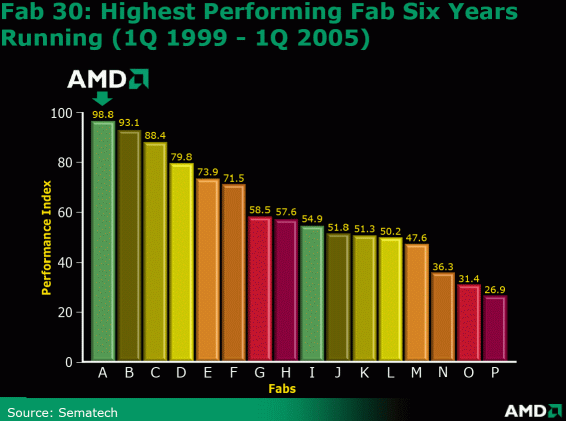
1.- There are objective reasons to think that APM is a very much superior method of production (at least compared to Intel's "Copy Exactly!"), things like Sematech's award for the highest performing fab:


2.- Fab30 was producing absurd percentages beyond official capacity, meaning that everything production-related was very good at AMD

3.- The partnership with IBM for the development of 65nm and 45nm inspired confidence about the 65nm transition goals

4.- When the fastest dual core was the FX-60 at 2.6 GHz , fastest single the FX-57 at 2.8 GHz, the overclockability of 90nm Athlons made me think that the production process itself was centered above 2.5 GHz with a very tight variance (due to the fantastic Fab30 over production, over clockability and top speeds).

These things taken together led me to believe that all was well regarding the production capabilities and schedules for the 65nm process and the yields and binsplits hits of quadcores.

And the new core design didn't seem a problem at all, we are speaking here of the "Grand Masters" who brought DCA, AMD64, AMD-V, the emphasis in instructions per clock rather than clock speed, and the K8 design is very old already, the designers should have had more than enough time to prepare a new design.

Has AMD any chance of succeeding with this strategy choice?

Of these three items we can only be sure that AMD is producing 65nm products, under the family name of "Brisbane". But regarding the 65nm process requirements for successful single die quadcores, several red flags arise:

Despite the inherent advantages of 65nm and the acute urgency to have competitive products, all AMD has done with Brisbane are:
  • Mysterious and "bullshit-explained" extra L2 latencies, that is, slower processors clock by clock
  • Unimpressive shrink of die area
  • Slower processors, up to 2.7 GHz when the company desperately needs something over 3.0 GHz and while some 90nm dual core products (the Quad FX 74) are 3.0 Ghz
  • Small quantities, especially if believing what the company says, that the crossover point in the transition to 65nm manufacturing and several other milestones have been reached.
It can categorically be said that current 65nm is not up to the requirements of successful single die quadcores. That is why it was no surprise at all the underwhelming clock speed of the officially demonstrated quadcores, around 1.7 GHz. It seems that the 65n process is so bad that only underclocked product works at all.

In this first part, we have seen how AMD's management chose an strategy for the flagship products that implied success at three major challenges. Today we don't have enough information to decide whether this was lunacy, overconfidence, or a calculated risk that went wrong; but since failure at Barcelona ripples in many ways for AMD's prospects, other strategic decisions must be seen in the context of the choices of Barcelona, that will be explored in successive parts.

Monday, May 07, 2007

Vista: Slower at 3D games

The review site "Hardocp" compared the average frame rates of several popular games, including Microsoft's very own "Flight Simulator" and found that Vista is noticeably slower.

Let's see the results for two popular video cards:
8800GTS results
7600GT results

One of the phony reasons Microsoft has given to the public for the transition to Vista is supposed to be better gaming experience. This claims have support because Vista supposedly provides services of interest for game developers. If so, it is to be expected that with the very low adoption rate of the operating system games still haven't been designed to exploit those benefits. But this doesn't explain why old games run slower.

Vista deals with video in a very different way to its predecessors, Microsoft insisted that the new "Windows Display Driver Model" was so different that DirectX 10 couldn't be backported to XP nor predecessors, but still, since the gaming segment is of great importance for Microsoft, and Microsoft has always cared about backward compatibility a very great deal, it could be expected that games for DirectX versions older than 9L would behave like they have always done; but this doesn't seem to be the case.

Why? I think the reason can be found in Peter Gutmann's "A Cost Analysis of Windows Vista Content Protection": The DRM-infected Vista device drivers must distrust the user, the other hardware devices and the software running in the computer to protect Microsoft's interests (claim explained here), and this obviously taxes performance. But of course, I am dismissing a plausible explanation that DirectX < 9L runs emulated for WDDM devices, because I think WDDM's potential technical benefits are just an excuse to force the device drivers DRM infection.

I may be wrong, but I get the impression that AMD (ATI, that is) has been cheerleading Vista much more than nVidia. This is off-topic, but I am concerned about AMD's management attitude towards Vista, for instance how they keep insisting that adoption will provide momentum for the industry. It makes me wonder if their policy decisions are based on this, like introducing 65nm product first for desktops, where its only attractive point of better power efficiency is relatively irrelevant compared to Laptops perhaps anticipating a spike in desktop demand due to Vista. I also wonder if AMD's management understands who used to be their custormers: Gamers, for instance, that wanted freedom, choice, the greatest bang for the buck and when K8 was the king of the jungle, performance leadership. Vista provides exactly the opposite: DRM infection, restriction in drivers and hardware, expensive proprietary bloatware; and performance retardation.

Tuesday, May 01, 2007

Ron (Cove3) rant about Options

What follows was written by Ron (Cove3) as a message board post, part of a thread we were talking about. I have inserted my commentary in a different color. My intention is to post a complete rebuttal, but for the time being I want to comment on Ron's ideas.

Chicago, I have read your link many times [Ron refers to "Options Are Cool", where I explain some benefits of options], but as you say, no argument will convince me. As regards personalizing, since you are a spokesman champion of options, I do, IN ONLY THIS INSTANCE, regard you as an adversary, much as I would were you the Tobacco industry proclaming the benefits of smoking or the Narcotics industry proclaiming the benefits of cocaine. Both would say, as would you about options, not harmful in moderation, but of course moderation is never what happens, but primarily abuse.

You, I and other longs on this board have lost money on AMD in part due to hedge funds and speculators having a vast arsenal of weapons with which to manipulate markets [I have lost money, and I was also convinced that some stock price manipulation happened, but today I see that manipulation or not, what I though was a solid company in reality is a very bad business, and that is more than enough to explain the money that I lost. Since this explanation is simpler, by Occam's razor it is better]. The wealthy have pooled their money into unregulated hedge funds giving them an ability to stampede stocks up at down at will (see Cramer [Jim Cramer even confessed that he knew multiple ways of how to manipulate stock prices]). Not being content with that atomic bomb weapon, they pile on more advantage on top of that.... Margin, naked shorting, derivatives, and of course options. [You are putting together very dissimilar things, this makes it harder to understand what is your complaint: Naked shorting is illegal, options are but a particular kind of derivatives, margin is necessary for any kind of short selling. Nevertheless, I will assume the defense of Margin, non-naked (proper) shorting, and options in particular]

The leverage this gives them to create volatility and gain is unimaginable and have turned what should be capital markets for long term investment for the good of all into mere gambling casinos. There's simply no rational for a company's entire outstanding stock to turn over in 3 or 4 days. AMD should never have driven up or driven down to the levels we've seen and wouldn't have been without the arsenal of weapons at their disposal, one of which you're so vigorously defending [Actually, I disagree with this argument for technical reasons that you are not aware of. To write options is a very great deal more complex than to go long on them, that may explain why most discount brokerages have more restrictions and demand more qualifications from option writers than option purchasers. Since to write options is a harder subject, and requires larger commitments of capital to obtain smaller gains, I conjecture that the activity of writing options is more natural for big players than for retail investors; this issue is key, because it contradicts your implication that these instruments are used to increase volatility: Whoever writes options is implicitly taking a stance, that volatility will decrease. Then, if Big Money assumes more often the role of option writer, it is not in its best interest to propitiate increased volatility. I see many good phenomena that explain why market volatility has increased, I will detail below and in my post]

The Fed and SEC could stop all this dead in it's tracks if it weren't controlled by Wall Street.
1. 100% margin [Why 100%? I understand that some people use margin leverage incorrectly, but there are ways to use lots of margin leverage that are even safer ways to invest than simply hold shares, and I will explain how]
2. 3 year holding period for long term capital gains, 3+ yrs being what an investment is all about. [This is ridiculous. Markets are not what they used to be because of many reasons, in particular, in this age a company like YouTube may go at "internet speed" from non-existence to being valued more than one billion dollars in less than the three years you mention. (YouTube in particular was demoed in May 2005 and announced its acquisition by Google in October 2006, less than half three years!. I don't see anything particularly bad with some legislation to be in accordance with the accelerated pace of our times. Your criticism distills strong opposition to liquidity, I can, on the other hand, show how liquidity is an essential positive characteristic of modern financial markets]
3. Tax capital gains and dividends at the same rate as labor, which needs incentive also.
[Allow me to mention some criticism about capital gains taxation that I do not necessarily agree with: If you agree that after the government receives the payments of income taxes, the remainder should be available to be used in any way the contributor chooses, thus, it has weak legitimacy to tax that money again because it multiplied as an investment. I would like to see your refutation of this argument]
4. Add a transaction tax to make it much more expensive to churn stocks. [More opposition to liquidity]
5. Tax inheritances to get at least some of the manipulation/inflation profiteering gains back [Well, this is an entirely different subject: It seems that you think that whoever leaves money in inheritance is guilty of some form of misdeed. This is a political discussion that I will decline to participate in]
6. Use this tax income to reduce the deficit, the burden of which falls primarily on the middle and lower classes who least know how to defend against the inflation which deficits create. [While it is true that the deficit is a middle and low classes killer, the solution is for the citizenry to demand legislation that blocks the government to expend more than its income, this has very little to do with our subject]
7. Ban or regulate hedge funds. [It seems that you hate any mechanism to invest that doesn't require explicit government permission. If you assume that the government is able to decide what ways are good to invest and which are not, then why wouldn't the government, in its infinite financial wisdom doesn't administrate all the money of every individual and company? You can't fire accusations so general, the system of individual liberties is based on the principle that agents can do as they please as long as they don't trample on the liberties of others, that is, government intervention occurs only to protect liberties, it doesn't work as you suggest: "Eliminate these liberties so that there is no abuses"]
6. Eliminate options. Risk can be managed by diversification or selling the investment [Why does it have to be diversification the only mechanism to handle risk? Diversification is very bad at it, risk may keep mountains of money from being invested if it were not for more developed mechanisms to handle it. Your blanket opposition more than anything else reflects ignorance]. Markets functioned before there were such a thing as options. [Many types of derivatives have existed since time immemorial, in recent times, there was ground breaking work that allowed investors to more easily agree about how to price equity options, the Black-Scholes model, and the rise of the options market is the natural consequence of that and other developments. You seem to oppose innovation because it may lead to changes that you don't like. I liked the times when you made a phone call and an actual person took the phone, I loathe and hate the automated voice systems that take your call, but I would not even suggest to outlaw them. Regarding your claim that markets functioned well before there were them, is factually wrong by duplicate: They have existed ever since the market existed, and there is no reason to think that old times were better. What is the difference between your attitude of being opposed to progress and the Fundamentalists who go to the extremes of killing people massively or to impose restrictions on half of the population, women, including denying fundamental rights as the right to be educated; only because they have an idea of how without modernity we would be better?]
All these tortured devices have gotten ownership further and further away from the real thing [yes, they have increased the level of abstraction from the underlying; but this is just a demonstration of the successful development of markets. Just as you have the option to actually buy a business and manage it and nevertheless you choose to take a step of abstraction and own the business indirectly through shares in the stock market, I very much defend my right to take one abstraction step more than you and use derivatives over the share ownership you seem to sanction as morally acceptable] and created massive pyramids which nobody understands [speak for yourself!, but really, don't you see the cognitive dissonance of claiming ignorance about the subject of options and yet being so strongly opposed to them?] Why not have an options market for options? [In a way it actually exists, financial institutions trade "pure" volatility]

It's also increased the disparity in wealth which history shows leads to bad things [This is another political stuff that I don't want to discuss, but it has a side very much pertinent to our discussion: You and I are technologists, that puts us in a very good position to understand the "regressive nature" of our times: Those countries, companies or individuals who get ahead from the pack in the usage of technology use that advantage to further develop technology and get an ever increasing advantage. See it from the point of view of two households, one with Internet, and the other without. This may be a difference as little as a few dollars per month, but which amplifies itself enormously, it is either a virtuous or vicious cycle, what in systems is properly addressed as "a positive feedback loop" meaning a system where a deviation from the equilibrium point leads the system to further deviation. Nevertheless, the argument that technology is to blame for poverty is wrong: although it doesn't benefit all equally, it benefits the whole. The same thing applies to the development of financial markets that allows for margin leverage and options.]. Warren Buffet said there's class warfare going on and his class in winning, [yes, but Warren Buffett's opinion is not that of a Luddite as you seem to imply, the way to correct this problem is not to tax Mr. Buffett up to dissuading him to invest in the stock market] thanks in part to weapons I've mentioned. The Imus uproar is just the tip of the iceberg.

Although I agree with many of your techology evaluations, on this one I'm afraid we will continue to be at loggerheads [being an engineer and/or scientist, I had the luxury of being raised intellectually in disciplines with objective criteria for truth and falsehood, I mean, I learned very early to accept that I made a mistake in a calculation, just the same I leaped to understand that I may be wrong with my opinions. Then, I learned that sometimes you only have approximations to the objective truth, and then that the same thing may be looked at from different models or frameworks that may lead to different conclusions and yet equally "right". Your opposition to even reconsider your opinions on this subject not just give me a higher moral ground, but cause you harm because those opinions are not what I call "operative". If you are concerned about how the options and other financial instruments induce volatility, you should be eager to learn everything about them, because like it or not, they exist. If you ever want to further these opinions into political action, you should be eager to know everything about the opposing arguments, because to "preach to the choir" would lead you nowhere. And finally, there is always the horrible possibility that one is plainly wrong. In that sense, I sincerely thank you, because your arguments provided me with good material to reflect about subjects of my interest and the effort to respond to them led me to improve my understanding].

Regards, Ron

Sunday, April 29, 2007

Big Merger == Bad Merger

At least mergers of companies of about the same size.

You can google about statistics relating big mergers, you will find that most of the time they end up destroying the bidder value and enriching the companies management. There is this old article from "Business Week" to begin with, and "Owners Lose and Bosses Win in Bad Mergers" from "The New York Times".

If the odds are against mergers, one wonders why they at all happen. One reason is that the bidding company becomes larger and thus its management tends to receive greater compensation, in line with the increased size; thus creating an incentive for management to merge regardless of the merits of every merging. Beyond that, Wall Street also benefits. The Investment Banking business of a big merger may leave literally hundreds of billion of dollars in gains for Wall Street's operators; this is a great incentive for Wall Street to persuade the management of companies thinking about the possibility of a merger to go forward, and also an incentive to use their leverage in the financial press and media to give good publicity to them, so that public opinion eases the process.

There are other incentives as well, for instance, it is rumored that Carly Fiorina at certain point wanted to make use of her celebrity status to further political aspirations, and the chance to get lots of media exposition was something like the Compaq merger. While I do not necessarily agree with this rumor, I mention it here because it is rather easy to imagine that things like that may happen.

What is important is that once the merger has completed, Wall Street's pirañas have got their money and the true value of the combined entity is allowed to emerge, destroying the shareholder value.

Of course that I am writing this in relation to AMD's ATI acquisition, the day the talks were announced that Monday after the presentation of Q2 '06 results, I couldn't help but think that all the talk about the synergies was empty, and all of those words of keeping working closely together with nVidia as outright lies. What was true was that Intel was going to cut businesses with ATI and that the merger was going to have high costs for AMD.

I explained to my satisfaction (at least for the time being) why I criticize this merger. I just want to hypothesize about why it happened: AMD's management is gullible because they have an inferiority complex (a subject I have been writing about) and anything that may upset Intel gets their interest. ATI's management knew the very poor condition of the company (yes, this is my gut feeling, I don't have evidence) and tricked their AMD's peers to bite the bait. Then, Wall Street's pirañas made sure it got through with good publicity and stock price manipulation... from less than $17 per share it got to over $27!, but now, it is becoming increasingly clear that AMD paid premium for a nest of lice.

Nevertheless, I have repeatedly stated it, there are projects that can really display AMD/ATI synergies, like torrenza 3D coprocessors. Sadly, for these few projects, AMD sees them from either the perspective of AMD or ATI but not the combined company's: To use ATI's expertise to develop physics torrenza coprocessors?: NO! they would "cannibalize" existing AMD processors businesses. 3D Graphics torrenza socket coprocessors?: Even worse! they would cannibalize the very lucrative —and absurd— "graphics supercomputer in a PCIe expansion card" businesses. Intel stubbornly insisted in the "Front Side Bus" approach to memory interfacing to defend chipset businesses. Did that insistence lead to anything good for Intel?. AMD neither learns from its failures nor its successes; just like the integrated memory controller was the right technical way to go, the torrenza socket graphics coprocessor is the right way to go; to not pursue this ATI acquisition synergy is just to give chances to Intel and nVidia to do it first. Fusion? DON'T GET ME STARTED!

The ATI acquisition, for the record

I have written in other posts about the ATI acquisition, but not compiled a definitive opinion on that subject, thus this post.

Vertical Integration is an attractive strategic objective for AMD:

  • AMD processors may have unique features that could benefit from chipsets that fully make use of them, chipsets and processors have synergies.
  • To develop chipsets next to the processors should lead to shorter "times to market", another important thing
  • The chipset business opens up opportunities for AMD to use its Fab capacity in chipsets, or to use the foundry capacity contracted by ATI, depending on the integrated company needs, which increases flexibility and in principle AMD readiness to tackle market opportunities.
  • As it has been profusely written about in this blog, there are specific computation loads such as 3D graphics acceleration that can be better served by specific coprocessors; thus, the future of the processors are as much "multicored" as "multicoprocessored", thus very tight collaboration with coprocessor companies was necessary for AMD.
  • From the point of view of the customer, tight development of chipsets and processors ensure compatibility
  • Access to other markets, through ATI, Consumer Electronics, for instance.
At the moment AMD acquired ATI, there was a conjunction of market conditions that aligned AMD's interests with the interests of the major players in the industry. Why? because Intel, especially in conjunction with a mono-supplied Dell, was as much a vertically integrated monopoly as an horizontal monopoly; then, every AMD processor sold instead of an Intel meant a whole chain of complementary products and services opportunities for all the other companies: nVidia and ATI for the chipset and the integrated graphics card, Sun, HP, or others for the computer itself; Broadcom or Marvell for the ethernet phy or the wireless chipset, and so on. In summary, the whole industry had only one enemy: The Intel-Dell axis.

This used to be a successful stage of the "Virtual Gorilla" strategy that AMD pursued to try to close the economies of scale gap to Intel. Remember that AMD's greatest problem is the economies of scale, the Silicon research and development costs can be viewed as essential (due to the restrictions the x86 license places on the number of processors that can be outsourced, AMD seems forced to fab itself a significant fraction of its designs), and they have a "fixed" nature, thus, the greater the number of units to spread the fixed cost, the better the margin. Furthermore, the Silicon fab process is increasing its scale with every node transition, meaning that the investments grow in size at the ever higher scales of integration. In any case, for the broadest markets both nVidia and ATI were providing excellent chipsets for AMD processors and had adopted technologies of interest for AMD like hypertransport. For supercomputers and specific market niches, Broadcom, Sun, Cray and others were doing an excellent work in making use of AMD's processor features. In summary, right before the acquisition, it can not be said that the market was lacking in support of AMD technologies or initiatives.

AMD thus had every chance to concentrate in Silicon research and development and capacity expansion. Continuing the partnership with IBM for R&D, there only remained the issue of capacity expansion itself that AMD was attending to by securing an excellent offer by the State of New York to build a fab there which included more than 1 giga dollars in bonuses.

With a rising market share, for both ATI and nVidia there wasn't a better long term strategical plan than to increase collaboration with AMD while competing among each other; this ensured that the market of products complementary to AMD processors, due to this competition, was going to evolve faster than Intel lines. To further speed up the development of complementary products, AMD may had enthused the industry with more open specifications like Hypertransport, or even get more directly involved with Joint Ventures with nVidia and ATI simultaneously.

AMD not just had credibility for all of this, AMD wouldn't become a competitor in the chipsets or coprocessors businesses for nVidia or any other industry player that chose to associate tightly with AMD because AMD only had money for one major initiative, if that was to pursue capacity expansion, the opportunity cost paid there would left AMD without the money to turn into a treacherous competitor the way Intel did.

Then, the benefits of Vertical Integration mentioned at the heading of this article were present in the Ecosystem of partners to a large degree. nVidia, for instance, had the nVidia Business Platform, which is still defined around an AMD processor. An aside note, when I first noticed the NBP around early April '06, it surprised me how nVidia addressed a very important concern of the business market, that of platform instability, with a very compelling proposition and yet wasn't promoting it heavily: In hindsight, I think nVidia knew AMD was about to acquire ATI, perhaps what Rahul Sood says is true, that nVidia was the first merger candidate tried and nVidia was already weary of AMD by that time. With nVidia pushing initiatives like this, ATI would have to follow suit.

Since the Vertical Integration was ensured by market circumstances around the time of the acquisition, comparatively the acquisition wouldn't have brought that many benefits. I mean, if If live in a place with excellent public transportation and my house badly needs a larger kitchen, I can defer the acquisition of a car to remodel the kitchen.

The criticism about the ATI acquisition is not a matter of principles, it is a matter of benefit/cost analysis. There were little and few true benefits to the acquisition, as it has been explained, but the costs have been terrible. Like it was explained in "long year", ATI was valued at certain price X by the market because it also had very good access to Intel product cycles, once inside AMD, it lost that access, and just by that fact, ATI, being exactly the same business, necessarily has to be worth much less, unless inside AMD it can participate in business with synergies to compensate. But so far what has been the synergies AMD has announced? A cut of redundant personnel? Fusion? has I have stated multiple times, the development schedule for Fusion is every bit as slow as it would have been in a Joint Venture; it is very clear that for the time being there haven't been any synergies which could justify the loss of value of ATI due to the difficulties to deal with Intel. This is important because Intel-based computers used to be over half of ATI's market.

Thus, AMD paid X plus an acquisition premium of about 20% for a business that is worth much less now that it is inside AMD. But this is not the real problem, the real problem is that AMD paid a dearly high opportunity cost.

While AMD needed its cash and future cash flows to keep expanding production capacity, it distracted both to acquire ATI. This problem gets worsened because:
  • The timing was particularly bad: At the same time AMD's management understood that its declining product competitiveness will hurt AMD's capacity to pull this transaction off, ATI was depreciating even faster because of its own lack of competitiveness, spotty execution and profitabilities. Since Intel already had declined to acquire ATI, AMD may very well have waited for a cheaper opportunity (this is the same argument that dispels the rumor of AMD's leveraged buy-out, why now that the price is becoming cheaper so fast?)
  • Furthermore, AMD needed lots of cash to cover for a "Perfect Storm" that could happen, and happened, forcing it to loans that put a burden of about $1 per share per year just in interests.
  • AMD lost credibility among partners, I see it very hard for the ecosystem to risk any significant investment in AMD-based products if AMD demonstrated that it is not interested in the ecosystem but in imitating Intel's vertical integration model up to its treacherousness
  • nVidia, despite what Rahul Sood and AMD's management says, is not only alienated, but has become AMD's greatest enemy and probably its nemesis.
  • There are no resources for projects that can display ATI-AMD synergies like torrenza coprocessors (no money and no market credibility). Furthermore, AMD is very content with the current model of "graphics supercomputer in an expansion card" model that I demonstrated why it is obsolete. I dare to say that the ATI acquisition, far from easing the adoption of unique features of AMD processors, like their "coprocessability", the prostrated AMD posture is eliminating chances for those product advantages to become competitive advantages and profit drivers. That is, AMD has gotten the opposite it wanted from the deal.
  • The financial damage is extreme: We are talking here of, according to my estimations, of a depreciation of ATI's value of at least 1 giga dollars, plus the 1 giga dollars of acquisition premium paid, plus several million dollars in the commissions and interests of the Morgan Stanley initial loan, plus the commissions, interests and transaction losses due to this recent convertibles issuing, some more hundreds of million dollars in increased risks and credit rating downgrades to be paid the next time AMD goes to financial markets, the financial shackles the Morgan Stanley loan imposed (AMD is forced to dedicate a significant portion of almost any financial activity to repay that loan)
The greatest damage of all I think it was to have destroyed a pro-AMD/anti-InHell alignment of business interests of all the major industry players to commit self-financial-mutilation and to become the primary business enemy of one of the greatest emerging new companies, nVidia.

Saturday, April 21, 2007

Trusted Computing

There are many initiatives that promote security and reliability addressed under the generic term of "Trusted Computing". Nevertheless, this term does not mean what the non-initiated think it means, and this ignorance has been used to sugar-coat mechanisms for intrusions of privacy and weakening of consumer rights. Since I have been posting about Vista and DRM that implement some "Trusted Computing" concepts, I thought appropriate to complement the discussion of those subjects with this topic.

Trusted Computing is not "trustworthy" computing. The word "trust" in this context has a meaning closer to its opposite, it comes from the Cold War era when the Department of Defense was the largest commissioner of technology projects and imprinted their military view on language, "trust" in this case means "risk". When an organization in the military gives you credentials to access the weapons in a depot, it is trusting you, because you may misuse the permissions and cause harm, that is, you are trusted not because you are trustworthy but because you have become a risk. When approaching "Trusted Computing" one must be very careful to understand what point of view is assumed.

There is a "Trusted Computing Group" founded by the usual suspects: AMD, Intel, Microsoft, IBM, Hewlett Packard, Sun Microsystems and Infineon that strives to develop technologies to make computing predictable, and consequently, more secure and reliable. AMD in particular, in relation to Virtualization has brought SVM, the Secure and Virtual Machine specification, what was known as "Pacífica/Presidio".

The goal of "Trusted Computing" is to make computing devices to behave in predictable ways, exactly as the designer and manufacturer expected. This is an attractive selling point because it is a manufacturer warranty that the devices are going to do what they are supposed to do. A computer infected with virus or malware would be a counterexample. When you have a TV set, if you push the power button and nothing happens, you exercise the warranty. Unless you opened it and messed with the circuits, the seller or manufacturer will quickly admit its fault; trusted computing tries to replicate that dynamics to computing devices.

But that warranty comes at a price: For the device to be "trusted", it can only do what the manufacturer has deemed appropriate and nothing else; and this is the problem, computing devices are generally better the more flexible but the "trusting" limits them to very specific things. This imposes limitations far beyond the usual restraint of not messing with the circuits of a TV set to not void the warranty or not touching a configuration of your Cisco router done by the the consultants so that they don't have an excuse to say "we left your network working, your people must have made a change that broke it"; trusting computing works because the devices are guaranteed to enforce the manufacturer's policies, they may be designed to ignore the requests of their lawful owners, or even worse, to report to authorities, including the manufacturer, attemts at breaking the mechanisms that guarantee the enforcement of policies as tampering. "Trusted Platforms" among other positive things mean platforms designed to disobey the user to guarantee the enforcement of the policies coded by the manufacturer, as very aptly Richard Stallman put it.

In connection with my previous discussions about Vista and DRM, for example, the limit in the number of times you may change the "zone" of a DVD is an example of "trusted computing": The DVD consortium imposes policies regarding which players may play which DVDs that the devices enforce, even against the express wishes of their lawful owners and users. The DMCA criminalizes the circumvention of "protection" mechanisms, that is, it is criminal to interfere with the enforcement of the policies coded into the devices. Observe that just like one must be careful to notice what is the point of view about "Trust", in this context it is equally important to notice the point of view of the words "Copyright" (1), "Security", "Protection".

Microsoft sells Vista as an O.S. with improved security, but in reality that is a marketing claim with little support. It is true that Vista keeps asking you for permission to do things that require administrative privileges, but since it is so annoying, you end up clicking "yes" without thinking the same way you pretty much ignore the internet browser warnings on "secured" or "unsecured" transactions, or never take a look at the warnings regarding the validity of cryptographic certificates(2); then in practice this annoyance barely improves security; or this other thing of bitlocker; it is nice to have the Operating System to check the validity of BIOS and the hard disk partition where the O.S. resides, but in the end, this is just a tool to block users to boot Linux after installing Vista: The Linux tools regarding bootstrap that worked magnificently to correct problems with Windows 2000 and Windows XP boot can't work with Vista booting and the user is locked to use the very defficient Microsoft tools, deteriorating boot security in your systems!. Anyway, all the colander of holes in Windows security are just the same in Vista.

So, the "Trusted Computing" may mean improved security in the sense that the computing devices will not do something harmful to the interests of the manufacturer although the user may experience more problems. Just as it is easier to infect Vista with a virus causing harm to the user/licensee/owner than it is to correct a Vista booting problem with Linux tools, Microsoft's interests are better preserved with Vista, in that sense it is more secure, at least from Microsoft's point of view, although not the user/licensee/owner's. My advise would be to not pay Microsoft extra money to protect its interests hurting yours.

When the devices guarantee the enforcement of policies, you can put DRM on top. With DRM the media companies may feel "secure" to publish their content for that DRM; the problem for the user/licensee/owner is that she has to waive her privacy and consumer rights.

For AMD, the "Trusted Computing" thing is harmful, because AMD/ATI does not have the critical mass to impose its "Trusted Computing" mechanisms as de facto standards while it needs innovation to take market and mind share from Intel but the emphasis in predictability intrinsic in "Trusted Computing" hurts innovation, as has been explained in detail in my previous posts.

On a personal level, you can construct your own "Trusted Computing" experience: I wrote about how thanks to Virtualization you can work around the severe Windows security problems [this points to the fragment that details how], if you read that other post, you will see that distrusting both the host Operating System and the Guest Operating Systems, breaking on purpose insecurity vectors like the Internet Explorer, and denying privileges to Guest Operating Systems you get more predictability, security and reliability.

If you own businesses, I would advise you to cease using Microsoft Office, to institute a policy of working memos, letters and internal messaging in html whenever possible rather than proprietary formats and tools, and running Linux hosts with virtualization Windows Guests. You would be applying "Trusted Computing" principles to increase productivity:

  • Microsoft Office is so complex that among other things it is prone to security vulnerabilities, to crash, and all kinds of hard to predict behaviours; then, if there is a problem, you don't know what's wrong, you have to scramble to provide a solution to your idled employee, your employee needs more time to learn a complex tool rather than your business needs, you encourage your secretaries to distract "fixing the margins on the page" rather than the real writing. A substitution for HTML will help in many ways, including predictability to your business productivity.
  • Linux gives you incredible flexibility, in this context, I am advising Linux as a platform where you can easily construct your own standard configuration where you minimize the number of applications and services in the interests of simplicity, predictability and security; since you may have needs that can only be satisfied with Windows, you can sandbox the Windows problems inside virtual machines; see that in this case you limit and control what can happen inside a Windows machine from the host that is an Operating System much easier to administer.
  • This is not advocating to distrust the employee, although the techniques work very well for that purpose. Rather than using trusting computing principles in an employee-hostile way, you can use the benefits derived from the implementation of employee-friendly trusted computing principles to further improve job satisfaction. For example, a computer fully equiped to comfortably run Linux, Gnome or KDE, with normal tools and even a Windows 2000 virtual machine costs as little as $250 without monitor instead of the ~$800 a Windows Vista with Microsoft Office licenses would cost; with the $550 difference you may buy a gigantic LCD screen and lots of RAM (that *will* be fully made use by Linux) for a very responsive, reliable and pleasant system to use [beyond Microsoft Office, after all those computers would not have the "printer driver" bloatware that comes with any Epson, HP, Dell, Lexmark, Cannon or whatever firm, it won't have Norton antivirus, firewall, anti-adware, it won't have the many "trialwares" that in reality are "adware" your OEM forced you to accept, it won't have the Yahoo messenger nor the MSN; nor any of the productivity zapping junk most Windows computers have, but their well-thought of substitutes]
Notes:
(1) I don't like the word "Copyright" because whoever has the copyright in reality may or may not exercise the right to copy but always imposes a prohibition to copy in all other entities, thus, what is really "owned" is the universal prohibition of copies. To clarify: Copyright is not the right to copy but the faculty to prohibit others to copy. An example: Apple has to pay to the copyright holders for the right to copy (and sell) songs in iTunes. But is Apple the owner of the copyright?, no, it is just a licensee. What is owned by the Music companies, then? a right or the faculty to impose a prohibition?. I propose copyprohibition as a better word. Furthermore, the "ownership" of copyrights imposes a burden on the rest of the society, to enforce the copy prohibition. It worries me that this form of artificial property requires not only the burden of enforcement to exist, but that its enforcement is harmful to liberties essential to prevent tyrannies. Since it costs nothing to allow people to copy, but it costs to prohibit to copy "copyrighted" works, "copyright" seems a particularly bad word for the concept.

(2) I laugh at the many inconsistencies at hotmail.com and msn.com regarding Microsoft's web certificates; they are assigned to one Microsoft domain but used at another, sometimes they are expired, etc. I understand that the certificates management is hard to do; for instance, you can not just copy a web site to another domain, you must update the certificates code; the web master must be very attentive to their validity, etc.; but if something this delicate, the only way the browsers can be sure that, for instance, "Windows Update" is the real thing and not a spoof copy to seed malware, can not be done by the largest technology company exposing hundreds of millions of computers to several internet attacks; there is very little hope for smaller firms...

The Old Man and the Sea

AMD is like Santiago, the perennial loser who went to sea one time and after an epic battle against all odds manages to fish the greatest Marlin of all times; all for nothing because the sharks eat the fish and when he goes back home his peers mistake the skeleton for that of a shark.

AMD breaks ground with innovation, beats Intel routinely at design, but always has to endure the shame of severe losses 'cos it doesn't turn competitive advantages into profits.

The ATI acquisition is this giant Marlin. AMD may fish it, but not make use of it.