Wednesday, June 13, 2007

Does AMD know what it is doing? - Strategy

Examination of AMD's strategy induce several tough questions that I want to explore in a multi-part series.

Today, I will address the strategies around single die quadcores

Barcelona:

Intel's approach of putting together two dual cores is inefficient because both dual core chips compete with each other and with the expansion buses to access memory. The chips also block the bus while they are communicating among themselves. In this design, the bottleneck is the shared bus, every new core added diminishes the bandwidth the other cores may have. From the point of view of the customer, although going from dual cores to quadcores requires double the power consumption and it doesn't give anything nearly twice the performance, it may be cost-effective because most software licenses are charged based on the number of processors, not the number of cores. Then, for about the same cost in Software licenses, the quadcores provide substantially more performance. From the production point of view, there is an additional cost with MCM (Multi Chip Modules, packages with several chips), but there is no problem regarding yields or raw speeds because the dual cores put together are basically normal.

In AMD's DCA (Direct Connect Architecture) to add processors increases overall bandwidth because every processor drives its own set of memory banks, and each processor has "Cache Coherent Hypertransport" links to other processors to allow them to share memory. This is why AMD had many choices about the design for quadcores. It could have used a multi chip slave/master configuration in which only the "master" chip is actually connected to memory or other processors, but it chose the "clean" option of single-die quadcores.

Like most other AMD fans, I was very enthusiastic about AMD's designs because they are much superior to Intel's, but to succeed with single die quadcore design implies to succeed at three though challenges:

  1. Contrary to the MCM approach, single die quadcores imply a yield and binsplit hit, a potentially devastating blow that can erase any performance or production cost advantages: For a quadcore to work at 3 GHz, obviously all four individual cores must be able to run at 3 GHz. Let us speak of an hypothetical example, say that the current production techniques give 20% of dual cores good enough to run faster than 2.8 GHz; then, if the process behaves just as well with the Quadcore design, then merely... 4% of the quadcores will be capable of running at that speed. I illustrated this argument of exponential worsening of yields in "65nm is just Intel Marketing", and will treat the subject in greater detail later on. But for the time being, it is clear that this issue is a pervasive problem regarding single die quadcores
  2. AMD deemed impractical to do quadcores with the 90nm process, perhaps rightfully so, at 90nm there wasn't a transistor budget per die big enough for quadcores. Then, for the argument expressed earlier, not just the success or failure, but the life and death of the single die quadcores hinged on extraordinarily good 65nm process.
  3. Furthermore, to integrate four cores may require a core redesign, to include features like the shared L3 cache or more Hypertransport links.
As can be seen, the moment AMD chose to go for the single die quadcores, it must have had absolute confidence about succeeding at this triple challenge. While I understood how difficult the triple challenge was, I interpreted AMD's decision as proof that Management had confidential information that assured success, and thus, the company was in very good shape because in particular, the new 65nm process should have been working so great in early 2006. Needless to say, I was wrong, but there were some elements to think that AMD may have pulled off the 65nm tricks it needed:

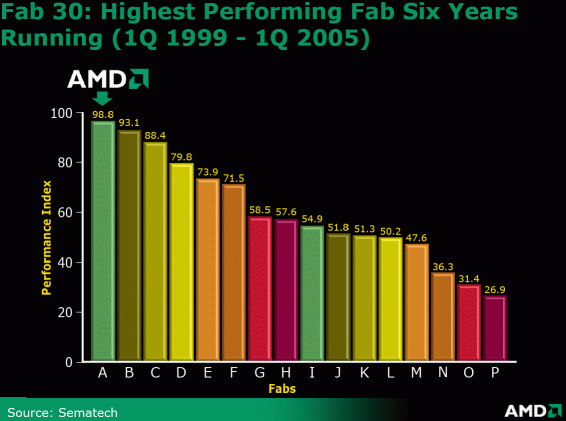
1.- There are objective reasons to think that APM is a very much superior method of production (at least compared to Intel's "Copy Exactly!"), things like Sematech's award for the highest performing fab:


2.- Fab30 was producing absurd percentages beyond official capacity, meaning that everything production-related was very good at AMD

3.- The partnership with IBM for the development of 65nm and 45nm inspired confidence about the 65nm transition goals

4.- When the fastest dual core was the FX-60 at 2.6 GHz , fastest single the FX-57 at 2.8 GHz, the overclockability of 90nm Athlons made me think that the production process itself was centered above 2.5 GHz with a very tight variance (due to the fantastic Fab30 over production, over clockability and top speeds).

These things taken together led me to believe that all was well regarding the production capabilities and schedules for the 65nm process and the yields and binsplits hits of quadcores.

And the new core design didn't seem a problem at all, we are speaking here of the "Grand Masters" who brought DCA, AMD64, AMD-V, the emphasis in instructions per clock rather than clock speed, and the K8 design is very old already, the designers should have had more than enough time to prepare a new design.

Has AMD any chance of succeeding with this strategy choice?

Of these three items we can only be sure that AMD is producing 65nm products, under the family name of "Brisbane". But regarding the 65nm process requirements for successful single die quadcores, several red flags arise:

Despite the inherent advantages of 65nm and the acute urgency to have competitive products, all AMD has done with Brisbane are:
  • Mysterious and "bullshit-explained" extra L2 latencies, that is, slower processors clock by clock
  • Unimpressive shrink of die area
  • Slower processors, up to 2.7 GHz when the company desperately needs something over 3.0 GHz and while some 90nm dual core products (the Quad FX 74) are 3.0 Ghz
  • Small quantities, especially if believing what the company says, that the crossover point in the transition to 65nm manufacturing and several other milestones have been reached.
It can categorically be said that current 65nm is not up to the requirements of successful single die quadcores. That is why it was no surprise at all the underwhelming clock speed of the officially demonstrated quadcores, around 1.7 GHz. It seems that the 65n process is so bad that only underclocked product works at all.

In this first part, we have seen how AMD's management chose an strategy for the flagship products that implied success at three major challenges. Today we don't have enough information to decide whether this was lunacy, overconfidence, or a calculated risk that went wrong; but since failure at Barcelona ripples in many ways for AMD's prospects, other strategic decisions must be seen in the context of the choices of Barcelona, that will be explored in successive parts.

Monday, May 07, 2007

Vista: Slower at 3D games

The review site "Hardocp" compared the average frame rates of several popular games, including Microsoft's very own "Flight Simulator" and found that Vista is noticeably slower.

Let's see the results for two popular video cards:
8800GTS results
7600GT results

One of the phony reasons Microsoft has given to the public for the transition to Vista is supposed to be better gaming experience. This claims have support because Vista supposedly provides services of interest for game developers. If so, it is to be expected that with the very low adoption rate of the operating system games still haven't been designed to exploit those benefits. But this doesn't explain why old games run slower.

Vista deals with video in a very different way to its predecessors, Microsoft insisted that the new "Windows Display Driver Model" was so different that DirectX 10 couldn't be backported to XP nor predecessors, but still, since the gaming segment is of great importance for Microsoft, and Microsoft has always cared about backward compatibility a very great deal, it could be expected that games for DirectX versions older than 9L would behave like they have always done; but this doesn't seem to be the case.

Why? I think the reason can be found in Peter Gutmann's "A Cost Analysis of Windows Vista Content Protection": The DRM-infected Vista device drivers must distrust the user, the other hardware devices and the software running in the computer to protect Microsoft's interests (claim explained here), and this obviously taxes performance. But of course, I am dismissing a plausible explanation that DirectX < 9L runs emulated for WDDM devices, because I think WDDM's potential technical benefits are just an excuse to force the device drivers DRM infection.

I may be wrong, but I get the impression that AMD (ATI, that is) has been cheerleading Vista much more than nVidia. This is off-topic, but I am concerned about AMD's management attitude towards Vista, for instance how they keep insisting that adoption will provide momentum for the industry. It makes me wonder if their policy decisions are based on this, like introducing 65nm product first for desktops, where its only attractive point of better power efficiency is relatively irrelevant compared to Laptops perhaps anticipating a spike in desktop demand due to Vista. I also wonder if AMD's management understands who used to be their custormers: Gamers, for instance, that wanted freedom, choice, the greatest bang for the buck and when K8 was the king of the jungle, performance leadership. Vista provides exactly the opposite: DRM infection, restriction in drivers and hardware, expensive proprietary bloatware; and performance retardation.

Tuesday, May 01, 2007

Ron (Cove3) rant about Options

What follows was written by Ron (Cove3) as a message board post, part of a thread we were talking about. I have inserted my commentary in a different color. My intention is to post a complete rebuttal, but for the time being I want to comment on Ron's ideas.

Chicago, I have read your link many times [Ron refers to "Options Are Cool", where I explain some benefits of options], but as you say, no argument will convince me. As regards personalizing, since you are a spokesman champion of options, I do, IN ONLY THIS INSTANCE, regard you as an adversary, much as I would were you the Tobacco industry proclaming the benefits of smoking or the Narcotics industry proclaiming the benefits of cocaine. Both would say, as would you about options, not harmful in moderation, but of course moderation is never what happens, but primarily abuse.

You, I and other longs on this board have lost money on AMD in part due to hedge funds and speculators having a vast arsenal of weapons with which to manipulate markets [I have lost money, and I was also convinced that some stock price manipulation happened, but today I see that manipulation or not, what I though was a solid company in reality is a very bad business, and that is more than enough to explain the money that I lost. Since this explanation is simpler, by Occam's razor it is better]. The wealthy have pooled their money into unregulated hedge funds giving them an ability to stampede stocks up at down at will (see Cramer [Jim Cramer even confessed that he knew multiple ways of how to manipulate stock prices]). Not being content with that atomic bomb weapon, they pile on more advantage on top of that.... Margin, naked shorting, derivatives, and of course options. [You are putting together very dissimilar things, this makes it harder to understand what is your complaint: Naked shorting is illegal, options are but a particular kind of derivatives, margin is necessary for any kind of short selling. Nevertheless, I will assume the defense of Margin, non-naked (proper) shorting, and options in particular]

The leverage this gives them to create volatility and gain is unimaginable and have turned what should be capital markets for long term investment for the good of all into mere gambling casinos. There's simply no rational for a company's entire outstanding stock to turn over in 3 or 4 days. AMD should never have driven up or driven down to the levels we've seen and wouldn't have been without the arsenal of weapons at their disposal, one of which you're so vigorously defending [Actually, I disagree with this argument for technical reasons that you are not aware of. To write options is a very great deal more complex than to go long on them, that may explain why most discount brokerages have more restrictions and demand more qualifications from option writers than option purchasers. Since to write options is a harder subject, and requires larger commitments of capital to obtain smaller gains, I conjecture that the activity of writing options is more natural for big players than for retail investors; this issue is key, because it contradicts your implication that these instruments are used to increase volatility: Whoever writes options is implicitly taking a stance, that volatility will decrease. Then, if Big Money assumes more often the role of option writer, it is not in its best interest to propitiate increased volatility. I see many good phenomena that explain why market volatility has increased, I will detail below and in my post]

The Fed and SEC could stop all this dead in it's tracks if it weren't controlled by Wall Street.
1. 100% margin [Why 100%? I understand that some people use margin leverage incorrectly, but there are ways to use lots of margin leverage that are even safer ways to invest than simply hold shares, and I will explain how]
2. 3 year holding period for long term capital gains, 3+ yrs being what an investment is all about. [This is ridiculous. Markets are not what they used to be because of many reasons, in particular, in this age a company like YouTube may go at "internet speed" from non-existence to being valued more than one billion dollars in less than the three years you mention. (YouTube in particular was demoed in May 2005 and announced its acquisition by Google in October 2006, less than half three years!. I don't see anything particularly bad with some legislation to be in accordance with the accelerated pace of our times. Your criticism distills strong opposition to liquidity, I can, on the other hand, show how liquidity is an essential positive characteristic of modern financial markets]
3. Tax capital gains and dividends at the same rate as labor, which needs incentive also.
[Allow me to mention some criticism about capital gains taxation that I do not necessarily agree with: If you agree that after the government receives the payments of income taxes, the remainder should be available to be used in any way the contributor chooses, thus, it has weak legitimacy to tax that money again because it multiplied as an investment. I would like to see your refutation of this argument]
4. Add a transaction tax to make it much more expensive to churn stocks. [More opposition to liquidity]
5. Tax inheritances to get at least some of the manipulation/inflation profiteering gains back [Well, this is an entirely different subject: It seems that you think that whoever leaves money in inheritance is guilty of some form of misdeed. This is a political discussion that I will decline to participate in]
6. Use this tax income to reduce the deficit, the burden of which falls primarily on the middle and lower classes who least know how to defend against the inflation which deficits create. [While it is true that the deficit is a middle and low classes killer, the solution is for the citizenry to demand legislation that blocks the government to expend more than its income, this has very little to do with our subject]
7. Ban or regulate hedge funds. [It seems that you hate any mechanism to invest that doesn't require explicit government permission. If you assume that the government is able to decide what ways are good to invest and which are not, then why wouldn't the government, in its infinite financial wisdom doesn't administrate all the money of every individual and company? You can't fire accusations so general, the system of individual liberties is based on the principle that agents can do as they please as long as they don't trample on the liberties of others, that is, government intervention occurs only to protect liberties, it doesn't work as you suggest: "Eliminate these liberties so that there is no abuses"]
6. Eliminate options. Risk can be managed by diversification or selling the investment [Why does it have to be diversification the only mechanism to handle risk? Diversification is very bad at it, risk may keep mountains of money from being invested if it were not for more developed mechanisms to handle it. Your blanket opposition more than anything else reflects ignorance]. Markets functioned before there were such a thing as options. [Many types of derivatives have existed since time immemorial, in recent times, there was ground breaking work that allowed investors to more easily agree about how to price equity options, the Black-Scholes model, and the rise of the options market is the natural consequence of that and other developments. You seem to oppose innovation because it may lead to changes that you don't like. I liked the times when you made a phone call and an actual person took the phone, I loathe and hate the automated voice systems that take your call, but I would not even suggest to outlaw them. Regarding your claim that markets functioned well before there were them, is factually wrong by duplicate: They have existed ever since the market existed, and there is no reason to think that old times were better. What is the difference between your attitude of being opposed to progress and the Fundamentalists who go to the extremes of killing people massively or to impose restrictions on half of the population, women, including denying fundamental rights as the right to be educated; only because they have an idea of how without modernity we would be better?]
All these tortured devices have gotten ownership further and further away from the real thing [yes, they have increased the level of abstraction from the underlying; but this is just a demonstration of the successful development of markets. Just as you have the option to actually buy a business and manage it and nevertheless you choose to take a step of abstraction and own the business indirectly through shares in the stock market, I very much defend my right to take one abstraction step more than you and use derivatives over the share ownership you seem to sanction as morally acceptable] and created massive pyramids which nobody understands [speak for yourself!, but really, don't you see the cognitive dissonance of claiming ignorance about the subject of options and yet being so strongly opposed to them?] Why not have an options market for options? [In a way it actually exists, financial institutions trade "pure" volatility]

It's also increased the disparity in wealth which history shows leads to bad things [This is another political stuff that I don't want to discuss, but it has a side very much pertinent to our discussion: You and I are technologists, that puts us in a very good position to understand the "regressive nature" of our times: Those countries, companies or individuals who get ahead from the pack in the usage of technology use that advantage to further develop technology and get an ever increasing advantage. See it from the point of view of two households, one with Internet, and the other without. This may be a difference as little as a few dollars per month, but which amplifies itself enormously, it is either a virtuous or vicious cycle, what in systems is properly addressed as "a positive feedback loop" meaning a system where a deviation from the equilibrium point leads the system to further deviation. Nevertheless, the argument that technology is to blame for poverty is wrong: although it doesn't benefit all equally, it benefits the whole. The same thing applies to the development of financial markets that allows for margin leverage and options.]. Warren Buffet said there's class warfare going on and his class in winning, [yes, but Warren Buffett's opinion is not that of a Luddite as you seem to imply, the way to correct this problem is not to tax Mr. Buffett up to dissuading him to invest in the stock market] thanks in part to weapons I've mentioned. The Imus uproar is just the tip of the iceberg.

Although I agree with many of your techology evaluations, on this one I'm afraid we will continue to be at loggerheads [being an engineer and/or scientist, I had the luxury of being raised intellectually in disciplines with objective criteria for truth and falsehood, I mean, I learned very early to accept that I made a mistake in a calculation, just the same I leaped to understand that I may be wrong with my opinions. Then, I learned that sometimes you only have approximations to the objective truth, and then that the same thing may be looked at from different models or frameworks that may lead to different conclusions and yet equally "right". Your opposition to even reconsider your opinions on this subject not just give me a higher moral ground, but cause you harm because those opinions are not what I call "operative". If you are concerned about how the options and other financial instruments induce volatility, you should be eager to learn everything about them, because like it or not, they exist. If you ever want to further these opinions into political action, you should be eager to know everything about the opposing arguments, because to "preach to the choir" would lead you nowhere. And finally, there is always the horrible possibility that one is plainly wrong. In that sense, I sincerely thank you, because your arguments provided me with good material to reflect about subjects of my interest and the effort to respond to them led me to improve my understanding].

Regards, Ron

Sunday, April 29, 2007

Big Merger == Bad Merger

At least mergers of companies of about the same size.

You can google about statistics relating big mergers, you will find that most of the time they end up destroying the bidder value and enriching the companies management. There is this old article from "Business Week" to begin with, and "Owners Lose and Bosses Win in Bad Mergers" from "The New York Times".

If the odds are against mergers, one wonders why they at all happen. One reason is that the bidding company becomes larger and thus its management tends to receive greater compensation, in line with the increased size; thus creating an incentive for management to merge regardless of the merits of every merging. Beyond that, Wall Street also benefits. The Investment Banking business of a big merger may leave literally hundreds of billion of dollars in gains for Wall Street's operators; this is a great incentive for Wall Street to persuade the management of companies thinking about the possibility of a merger to go forward, and also an incentive to use their leverage in the financial press and media to give good publicity to them, so that public opinion eases the process.

There are other incentives as well, for instance, it is rumored that Carly Fiorina at certain point wanted to make use of her celebrity status to further political aspirations, and the chance to get lots of media exposition was something like the Compaq merger. While I do not necessarily agree with this rumor, I mention it here because it is rather easy to imagine that things like that may happen.

What is important is that once the merger has completed, Wall Street's pirañas have got their money and the true value of the combined entity is allowed to emerge, destroying the shareholder value.

Of course that I am writing this in relation to AMD's ATI acquisition, the day the talks were announced that Monday after the presentation of Q2 '06 results, I couldn't help but think that all the talk about the synergies was empty, and all of those words of keeping working closely together with nVidia as outright lies. What was true was that Intel was going to cut businesses with ATI and that the merger was going to have high costs for AMD.

I explained to my satisfaction (at least for the time being) why I criticize this merger. I just want to hypothesize about why it happened: AMD's management is gullible because they have an inferiority complex (a subject I have been writing about) and anything that may upset Intel gets their interest. ATI's management knew the very poor condition of the company (yes, this is my gut feeling, I don't have evidence) and tricked their AMD's peers to bite the bait. Then, Wall Street's pirañas made sure it got through with good publicity and stock price manipulation... from less than $17 per share it got to over $27!, but now, it is becoming increasingly clear that AMD paid premium for a nest of lice.

Nevertheless, I have repeatedly stated it, there are projects that can really display AMD/ATI synergies, like torrenza 3D coprocessors. Sadly, for these few projects, AMD sees them from either the perspective of AMD or ATI but not the combined company's: To use ATI's expertise to develop physics torrenza coprocessors?: NO! they would "cannibalize" existing AMD processors businesses. 3D Graphics torrenza socket coprocessors?: Even worse! they would cannibalize the very lucrative —and absurd— "graphics supercomputer in a PCIe expansion card" businesses. Intel stubbornly insisted in the "Front Side Bus" approach to memory interfacing to defend chipset businesses. Did that insistence lead to anything good for Intel?. AMD neither learns from its failures nor its successes; just like the integrated memory controller was the right technical way to go, the torrenza socket graphics coprocessor is the right way to go; to not pursue this ATI acquisition synergy is just to give chances to Intel and nVidia to do it first. Fusion? DON'T GET ME STARTED!

The ATI acquisition, for the record

I have written in other posts about the ATI acquisition, but not compiled a definitive opinion on that subject, thus this post.

Vertical Integration is an attractive strategic objective for AMD:

  • AMD processors may have unique features that could benefit from chipsets that fully make use of them, chipsets and processors have synergies.
  • To develop chipsets next to the processors should lead to shorter "times to market", another important thing
  • The chipset business opens up opportunities for AMD to use its Fab capacity in chipsets, or to use the foundry capacity contracted by ATI, depending on the integrated company needs, which increases flexibility and in principle AMD readiness to tackle market opportunities.
  • As it has been profusely written about in this blog, there are specific computation loads such as 3D graphics acceleration that can be better served by specific coprocessors; thus, the future of the processors are as much "multicored" as "multicoprocessored", thus very tight collaboration with coprocessor companies was necessary for AMD.
  • From the point of view of the customer, tight development of chipsets and processors ensure compatibility
  • Access to other markets, through ATI, Consumer Electronics, for instance.
At the moment AMD acquired ATI, there was a conjunction of market conditions that aligned AMD's interests with the interests of the major players in the industry. Why? because Intel, especially in conjunction with a mono-supplied Dell, was as much a vertically integrated monopoly as an horizontal monopoly; then, every AMD processor sold instead of an Intel meant a whole chain of complementary products and services opportunities for all the other companies: nVidia and ATI for the chipset and the integrated graphics card, Sun, HP, or others for the computer itself; Broadcom or Marvell for the ethernet phy or the wireless chipset, and so on. In summary, the whole industry had only one enemy: The Intel-Dell axis.

This used to be a successful stage of the "Virtual Gorilla" strategy that AMD pursued to try to close the economies of scale gap to Intel. Remember that AMD's greatest problem is the economies of scale, the Silicon research and development costs can be viewed as essential (due to the restrictions the x86 license places on the number of processors that can be outsourced, AMD seems forced to fab itself a significant fraction of its designs), and they have a "fixed" nature, thus, the greater the number of units to spread the fixed cost, the better the margin. Furthermore, the Silicon fab process is increasing its scale with every node transition, meaning that the investments grow in size at the ever higher scales of integration. In any case, for the broadest markets both nVidia and ATI were providing excellent chipsets for AMD processors and had adopted technologies of interest for AMD like hypertransport. For supercomputers and specific market niches, Broadcom, Sun, Cray and others were doing an excellent work in making use of AMD's processor features. In summary, right before the acquisition, it can not be said that the market was lacking in support of AMD technologies or initiatives.

AMD thus had every chance to concentrate in Silicon research and development and capacity expansion. Continuing the partnership with IBM for R&D, there only remained the issue of capacity expansion itself that AMD was attending to by securing an excellent offer by the State of New York to build a fab there which included more than 1 giga dollars in bonuses.

With a rising market share, for both ATI and nVidia there wasn't a better long term strategical plan than to increase collaboration with AMD while competing among each other; this ensured that the market of products complementary to AMD processors, due to this competition, was going to evolve faster than Intel lines. To further speed up the development of complementary products, AMD may had enthused the industry with more open specifications like Hypertransport, or even get more directly involved with Joint Ventures with nVidia and ATI simultaneously.

AMD not just had credibility for all of this, AMD wouldn't become a competitor in the chipsets or coprocessors businesses for nVidia or any other industry player that chose to associate tightly with AMD because AMD only had money for one major initiative, if that was to pursue capacity expansion, the opportunity cost paid there would left AMD without the money to turn into a treacherous competitor the way Intel did.

Then, the benefits of Vertical Integration mentioned at the heading of this article were present in the Ecosystem of partners to a large degree. nVidia, for instance, had the nVidia Business Platform, which is still defined around an AMD processor. An aside note, when I first noticed the NBP around early April '06, it surprised me how nVidia addressed a very important concern of the business market, that of platform instability, with a very compelling proposition and yet wasn't promoting it heavily: In hindsight, I think nVidia knew AMD was about to acquire ATI, perhaps what Rahul Sood says is true, that nVidia was the first merger candidate tried and nVidia was already weary of AMD by that time. With nVidia pushing initiatives like this, ATI would have to follow suit.

Since the Vertical Integration was ensured by market circumstances around the time of the acquisition, comparatively the acquisition wouldn't have brought that many benefits. I mean, if If live in a place with excellent public transportation and my house badly needs a larger kitchen, I can defer the acquisition of a car to remodel the kitchen.

The criticism about the ATI acquisition is not a matter of principles, it is a matter of benefit/cost analysis. There were little and few true benefits to the acquisition, as it has been explained, but the costs have been terrible. Like it was explained in "long year", ATI was valued at certain price X by the market because it also had very good access to Intel product cycles, once inside AMD, it lost that access, and just by that fact, ATI, being exactly the same business, necessarily has to be worth much less, unless inside AMD it can participate in business with synergies to compensate. But so far what has been the synergies AMD has announced? A cut of redundant personnel? Fusion? has I have stated multiple times, the development schedule for Fusion is every bit as slow as it would have been in a Joint Venture; it is very clear that for the time being there haven't been any synergies which could justify the loss of value of ATI due to the difficulties to deal with Intel. This is important because Intel-based computers used to be over half of ATI's market.

Thus, AMD paid X plus an acquisition premium of about 20% for a business that is worth much less now that it is inside AMD. But this is not the real problem, the real problem is that AMD paid a dearly high opportunity cost.

While AMD needed its cash and future cash flows to keep expanding production capacity, it distracted both to acquire ATI. This problem gets worsened because:
  • The timing was particularly bad: At the same time AMD's management understood that its declining product competitiveness will hurt AMD's capacity to pull this transaction off, ATI was depreciating even faster because of its own lack of competitiveness, spotty execution and profitabilities. Since Intel already had declined to acquire ATI, AMD may very well have waited for a cheaper opportunity (this is the same argument that dispels the rumor of AMD's leveraged buy-out, why now that the price is becoming cheaper so fast?)
  • Furthermore, AMD needed lots of cash to cover for a "Perfect Storm" that could happen, and happened, forcing it to loans that put a burden of about $1 per share per year just in interests.
  • AMD lost credibility among partners, I see it very hard for the ecosystem to risk any significant investment in AMD-based products if AMD demonstrated that it is not interested in the ecosystem but in imitating Intel's vertical integration model up to its treacherousness
  • nVidia, despite what Rahul Sood and AMD's management says, is not only alienated, but has become AMD's greatest enemy and probably its nemesis.
  • There are no resources for projects that can display ATI-AMD synergies like torrenza coprocessors (no money and no market credibility). Furthermore, AMD is very content with the current model of "graphics supercomputer in an expansion card" model that I demonstrated why it is obsolete. I dare to say that the ATI acquisition, far from easing the adoption of unique features of AMD processors, like their "coprocessability", the prostrated AMD posture is eliminating chances for those product advantages to become competitive advantages and profit drivers. That is, AMD has gotten the opposite it wanted from the deal.
  • The financial damage is extreme: We are talking here of, according to my estimations, of a depreciation of ATI's value of at least 1 giga dollars, plus the 1 giga dollars of acquisition premium paid, plus several million dollars in the commissions and interests of the Morgan Stanley initial loan, plus the commissions, interests and transaction losses due to this recent convertibles issuing, some more hundreds of million dollars in increased risks and credit rating downgrades to be paid the next time AMD goes to financial markets, the financial shackles the Morgan Stanley loan imposed (AMD is forced to dedicate a significant portion of almost any financial activity to repay that loan)
The greatest damage of all I think it was to have destroyed a pro-AMD/anti-InHell alignment of business interests of all the major industry players to commit self-financial-mutilation and to become the primary business enemy of one of the greatest emerging new companies, nVidia.

Saturday, April 21, 2007

Trusted Computing

There are many initiatives that promote security and reliability addressed under the generic term of "Trusted Computing". Nevertheless, this term does not mean what the non-initiated think it means, and this ignorance has been used to sugar-coat mechanisms for intrusions of privacy and weakening of consumer rights. Since I have been posting about Vista and DRM that implement some "Trusted Computing" concepts, I thought appropriate to complement the discussion of those subjects with this topic.

Trusted Computing is not "trustworthy" computing. The word "trust" in this context has a meaning closer to its opposite, it comes from the Cold War era when the Department of Defense was the largest commissioner of technology projects and imprinted their military view on language, "trust" in this case means "risk". When an organization in the military gives you credentials to access the weapons in a depot, it is trusting you, because you may misuse the permissions and cause harm, that is, you are trusted not because you are trustworthy but because you have become a risk. When approaching "Trusted Computing" one must be very careful to understand what point of view is assumed.

There is a "Trusted Computing Group" founded by the usual suspects: AMD, Intel, Microsoft, IBM, Hewlett Packard, Sun Microsystems and Infineon that strives to develop technologies to make computing predictable, and consequently, more secure and reliable. AMD in particular, in relation to Virtualization has brought SVM, the Secure and Virtual Machine specification, what was known as "Pacífica/Presidio".

The goal of "Trusted Computing" is to make computing devices to behave in predictable ways, exactly as the designer and manufacturer expected. This is an attractive selling point because it is a manufacturer warranty that the devices are going to do what they are supposed to do. A computer infected with virus or malware would be a counterexample. When you have a TV set, if you push the power button and nothing happens, you exercise the warranty. Unless you opened it and messed with the circuits, the seller or manufacturer will quickly admit its fault; trusted computing tries to replicate that dynamics to computing devices.

But that warranty comes at a price: For the device to be "trusted", it can only do what the manufacturer has deemed appropriate and nothing else; and this is the problem, computing devices are generally better the more flexible but the "trusting" limits them to very specific things. This imposes limitations far beyond the usual restraint of not messing with the circuits of a TV set to not void the warranty or not touching a configuration of your Cisco router done by the the consultants so that they don't have an excuse to say "we left your network working, your people must have made a change that broke it"; trusting computing works because the devices are guaranteed to enforce the manufacturer's policies, they may be designed to ignore the requests of their lawful owners, or even worse, to report to authorities, including the manufacturer, attemts at breaking the mechanisms that guarantee the enforcement of policies as tampering. "Trusted Platforms" among other positive things mean platforms designed to disobey the user to guarantee the enforcement of the policies coded by the manufacturer, as very aptly Richard Stallman put it.

In connection with my previous discussions about Vista and DRM, for example, the limit in the number of times you may change the "zone" of a DVD is an example of "trusted computing": The DVD consortium imposes policies regarding which players may play which DVDs that the devices enforce, even against the express wishes of their lawful owners and users. The DMCA criminalizes the circumvention of "protection" mechanisms, that is, it is criminal to interfere with the enforcement of the policies coded into the devices. Observe that just like one must be careful to notice what is the point of view about "Trust", in this context it is equally important to notice the point of view of the words "Copyright" (1), "Security", "Protection".

Microsoft sells Vista as an O.S. with improved security, but in reality that is a marketing claim with little support. It is true that Vista keeps asking you for permission to do things that require administrative privileges, but since it is so annoying, you end up clicking "yes" without thinking the same way you pretty much ignore the internet browser warnings on "secured" or "unsecured" transactions, or never take a look at the warnings regarding the validity of cryptographic certificates(2); then in practice this annoyance barely improves security; or this other thing of bitlocker; it is nice to have the Operating System to check the validity of BIOS and the hard disk partition where the O.S. resides, but in the end, this is just a tool to block users to boot Linux after installing Vista: The Linux tools regarding bootstrap that worked magnificently to correct problems with Windows 2000 and Windows XP boot can't work with Vista booting and the user is locked to use the very defficient Microsoft tools, deteriorating boot security in your systems!. Anyway, all the colander of holes in Windows security are just the same in Vista.

So, the "Trusted Computing" may mean improved security in the sense that the computing devices will not do something harmful to the interests of the manufacturer although the user may experience more problems. Just as it is easier to infect Vista with a virus causing harm to the user/licensee/owner than it is to correct a Vista booting problem with Linux tools, Microsoft's interests are better preserved with Vista, in that sense it is more secure, at least from Microsoft's point of view, although not the user/licensee/owner's. My advise would be to not pay Microsoft extra money to protect its interests hurting yours.

When the devices guarantee the enforcement of policies, you can put DRM on top. With DRM the media companies may feel "secure" to publish their content for that DRM; the problem for the user/licensee/owner is that she has to waive her privacy and consumer rights.

For AMD, the "Trusted Computing" thing is harmful, because AMD/ATI does not have the critical mass to impose its "Trusted Computing" mechanisms as de facto standards while it needs innovation to take market and mind share from Intel but the emphasis in predictability intrinsic in "Trusted Computing" hurts innovation, as has been explained in detail in my previous posts.

On a personal level, you can construct your own "Trusted Computing" experience: I wrote about how thanks to Virtualization you can work around the severe Windows security problems [this points to the fragment that details how], if you read that other post, you will see that distrusting both the host Operating System and the Guest Operating Systems, breaking on purpose insecurity vectors like the Internet Explorer, and denying privileges to Guest Operating Systems you get more predictability, security and reliability.

If you own businesses, I would advise you to cease using Microsoft Office, to institute a policy of working memos, letters and internal messaging in html whenever possible rather than proprietary formats and tools, and running Linux hosts with virtualization Windows Guests. You would be applying "Trusted Computing" principles to increase productivity:

  • Microsoft Office is so complex that among other things it is prone to security vulnerabilities, to crash, and all kinds of hard to predict behaviours; then, if there is a problem, you don't know what's wrong, you have to scramble to provide a solution to your idled employee, your employee needs more time to learn a complex tool rather than your business needs, you encourage your secretaries to distract "fixing the margins on the page" rather than the real writing. A substitution for HTML will help in many ways, including predictability to your business productivity.
  • Linux gives you incredible flexibility, in this context, I am advising Linux as a platform where you can easily construct your own standard configuration where you minimize the number of applications and services in the interests of simplicity, predictability and security; since you may have needs that can only be satisfied with Windows, you can sandbox the Windows problems inside virtual machines; see that in this case you limit and control what can happen inside a Windows machine from the host that is an Operating System much easier to administer.
  • This is not advocating to distrust the employee, although the techniques work very well for that purpose. Rather than using trusting computing principles in an employee-hostile way, you can use the benefits derived from the implementation of employee-friendly trusted computing principles to further improve job satisfaction. For example, a computer fully equiped to comfortably run Linux, Gnome or KDE, with normal tools and even a Windows 2000 virtual machine costs as little as $250 without monitor instead of the ~$800 a Windows Vista with Microsoft Office licenses would cost; with the $550 difference you may buy a gigantic LCD screen and lots of RAM (that *will* be fully made use by Linux) for a very responsive, reliable and pleasant system to use [beyond Microsoft Office, after all those computers would not have the "printer driver" bloatware that comes with any Epson, HP, Dell, Lexmark, Cannon or whatever firm, it won't have Norton antivirus, firewall, anti-adware, it won't have the many "trialwares" that in reality are "adware" your OEM forced you to accept, it won't have the Yahoo messenger nor the MSN; nor any of the productivity zapping junk most Windows computers have, but their well-thought of substitutes]
Notes:
(1) I don't like the word "Copyright" because whoever has the copyright in reality may or may not exercise the right to copy but always imposes a prohibition to copy in all other entities, thus, what is really "owned" is the universal prohibition of copies. To clarify: Copyright is not the right to copy but the faculty to prohibit others to copy. An example: Apple has to pay to the copyright holders for the right to copy (and sell) songs in iTunes. But is Apple the owner of the copyright?, no, it is just a licensee. What is owned by the Music companies, then? a right or the faculty to impose a prohibition?. I propose copyprohibition as a better word. Furthermore, the "ownership" of copyrights imposes a burden on the rest of the society, to enforce the copy prohibition. It worries me that this form of artificial property requires not only the burden of enforcement to exist, but that its enforcement is harmful to liberties essential to prevent tyrannies. Since it costs nothing to allow people to copy, but it costs to prohibit to copy "copyrighted" works, "copyright" seems a particularly bad word for the concept.

(2) I laugh at the many inconsistencies at hotmail.com and msn.com regarding Microsoft's web certificates; they are assigned to one Microsoft domain but used at another, sometimes they are expired, etc. I understand that the certificates management is hard to do; for instance, you can not just copy a web site to another domain, you must update the certificates code; the web master must be very attentive to their validity, etc.; but if something this delicate, the only way the browsers can be sure that, for instance, "Windows Update" is the real thing and not a spoof copy to seed malware, can not be done by the largest technology company exposing hundreds of millions of computers to several internet attacks; there is very little hope for smaller firms...

The Old Man and the Sea

AMD is like Santiago, the perennial loser who went to sea one time and after an epic battle against all odds manages to fish the greatest Marlin of all times; all for nothing because the sharks eat the fish and when he goes back home his peers mistake the skeleton for that of a shark.

AMD breaks ground with innovation, beats Intel routinely at design, but always has to endure the shame of severe losses 'cos it doesn't turn competitive advantages into profits.

The ATI acquisition is this giant Marlin. AMD may fish it, but not make use of it.

Friday, April 20, 2007

How AMD misses opportunities due to DRM

[article finished]

Tom Yager (a very good articulist) wrote about AMD's plans to block the frame buffer access to unauthorized software. This means that the computer owner potentially will not be able to, for instance, take a screenshot of the screen to save it into a file.

This is something to be expected now that Microsoft Vista has been launched. I have written before about Vista (index), but I want to focus on AMD's insistence in becoming the closest Microsoft partner regarding it and how that "lacay" attitude harms AMD.

This is the key argument (taken from "Vista & DAT") to be treated in this article:

[T]he real problem for Microsoft and the Media companies is that while they can insist on control, and thus force their initiatives to be devoid of innovation, the rest of the world is still free to innovate, the innovation will still show up and be superior to what Microsoft and associates offer.
All Digital Rights Management(*) techniques are doomed to fail because of a very simple reason: For the customer to actually pay for the content and player, obviously she must be able to enjoy them, and to enjoy the content, it has to be unlocked to actually play it. This is where the problem lies: The content is unlocked at a point where the customer has control, whether it be a computer or a Blue Ray player or an iPod, and thus the customer may, depending on the laws, either legally or ilegally bypass the devices' DRM.

To close this loophole, the Media companies have succeeded to contractually force hardware manufacturers and software vendors to include DRM in the players, and lobbied very hard to make it illegal to modify them and to erode the law's protection of consumer privacy and personal freedoms. This success is causing harm, because the enforcement requires a "Police State": The only way a government may enforce laws against common people to "mod" their players is to have such powers of supervision of the people that they can detect the occurence of these activities. I think it should be a great "heads up" what is happening right now with the RIAA virtual racketeering against college students, single mothers, grandparents and children under the excuse of illegal file sharing; where the legal system gets inverted because it forces the accused to demonstrate their innocence while they only have the means of normal people against accusations financed with the billions of dollars of the recording industry.

Furthermore, the United States in particular enacted the Digital Millennium Copyright Act, which made it not just illegal but also criminal to even discuss vulnerabilities of DRM techniques. There is the famous case of Dmitry Sklyarov, who was arrested while briefly visiting the U.S. for work reasons and imprisoned for months just because he freely discussed the Adobe eBooks DRM vulnerabilities while working in Russia for a Russian company to illustrate the harmful extremes the enactment of laws that criminalize discussion of DRM techniques lead to. More off-topic, but very importantly, DRM harms by obfustating the invasion of customer privacy, DRM-infected products may be perfect trojan horses: They do whatever the provider wants them to do, and nobody knows what that is, furthermore, the government prohibits, through legislation like the DCMA, to even *discuss* what they may be doing(1).

Obviously, a country that denies to itself the possibility of digital content related innovation will lose competitiveness to the rest of the world, even if the country is by far the greatest content producer; because while every country can outlaw innovation within its borders, none can outlaw it in the whole world. For its own good, the greatest content producer country in the world should leverage that leadership into leadership of content players, its insistence in blocking innovation only postpones the inevitable and increases the costs of what will happen anyway.

Exactly the same thing happens with AMD and DRM, let us look at that in more detail:

Although the strategy of infecting content with DRM is ultimately doomed to fail, it is, using Mark Shuttleworth's words "attractive enough to some people that they are doomed to be tried again and again" too. The attractiveness is more or less this: Content owners won't distribute in "unsecured" (what an euphemism for "uncontrolled") channels, therefore some customers may accept prohibitions, to relinquish ownership rights and sacrifice privacy to enjoy the content not available without DRM infection. For Hardware and Software providers, this may mean that they have a chance to become monopolies of content distribution if they get the right DRM compromise, like Macrovision that receives royalties for every DRM infected DVD or Apple with iTunes DRM'ed tracks; part of the attractiveness is that companies may *own* some DRM infection mechanisms, thus, the larger the "adoption" (that is, infection), the larger the monopoly.

Shuttleworth: "it only takes one crack" in the scheme to make all the opportunity costs in development and adoption delays, development costs, unreliability, customer insatisfaction, stiffened competition and etc. an empty expense, damaging the very companies that insisted in the DRM infections. For further confirmation, look at the strong initiative spearhearded by Apple to disinfect music tracks, they seem to understand that DRM blocks their progress more than what it enables competitors to arise, anyway, their real competition is the free-of-DRM MP3. If you look at today's DRM infected players, you will see that the greatest contributor to their complexity is the DRM management; it can't be any other way because they strive to do the impossible: To prohibit the content to be used freely while allowing the content to be used; the same thing makes it easy to crack the players(2).

Shuttleworth gets to the gist of the whole thing when he says (original emphasis):
Someone will find a business model that doesn’t depend on the old way of thinking, and if it is not you, then they will eat you alive. You will probably sue them, but this will be nothing but a defensive action as the industry reforms around their new business model, without you. And by the industry I don’t mean your competitors - they will likely be in the same hole - but your suppliers and your customers. The distributors of content are the ones at risk here, not the creators or the consumers.
Mr. Shuttleworth, having become a zillionaire of the kind who literally enjoyed a vacation in outer space, selling Free and Open Source Linux, has every credential about how to make money in new paradigms: "The truth is that survival in any market depends on your ability to keep up with what is possible", "[t]he truth is also that, as the landscape changes, different business models come and go in their viability. Those folks who try to impose analog rules on digital content will find themselves on the wrong side of the tidal wave [...] It’s necessary to innovate [to] stay ahead of the curve, perhaps even being willing to cannibalize your own existing business". "The content owners need to [think] how they turn this networked world to their advantage, not fight the tide, and also how to restructure the costs inherent in their own businesses to make them more in line with the sorts of revenues that are possible in a totally digital world".How does this apply to AMD?:

It has been demonstrated how DRM infections only temporarily benefit the companies that gain adoption fastest, until they become monopolies due to the excellent powers to contain the competition that DRM gives them. Thus, at the same time, the infections are very harmful for those blocked medium and especially small companies. ATI is important and large enough to have a chance at becoming one of those DRM sanctioned monopolies in computerized media distribution; but this is in shocking opposition to everything AMD has preached since time immemorial about fair competition and more importantly, opposed to standalone ATI, the combined AMD/ATI entity is a company that strives to grow that is at a great disadvantage to Intel in its chances to become king of DRM. Furthermore, the only instrument left for AMD's growth is innovation.

Just like Shuttleworth advises, AMD should try to partner with organizations interested in innovation. Again, I recommend Linux in particular. Imagine what would happen if AMD decided, rather than providing less than mediocre support for Linux, as exemplified here, to help Linux become the platform of choice for everything digital video (Linux already runs in multitude of consumer electronics devices with video capabilities and of course, all kinds of computers from PCs to Mega Clusters). It may happen that doing this AMD may unleash all the possibilities that new technologies have, to its great fortune.

Some examples off the top of my head, "I don't understand" why I can not use Wi-Fi to broadcast TV from my TV Tuner card in my desktop to all of my laptops if the tuner provides me with the video data, I should be able to plug that video data to, for instance, the VLC player to broadcast it through 802.11g wireless to be played in other VLCs. I should be able to log-in to my home desktop from my office at work and stream through the internet the video I decode there. I should be able to stream the video to my file server, that is not the same as my desktop. I should be able to time shift the tuning and recording of programs with my application of choice, not the very mediocre application that comes with the tuner. I should be able to have multiple tuners in multiple computers to watch several channels at once in any of my computers. It should be possible to program my graphics accelerator to do video transcoding and audio processing of the feeds I get from the tuner.

Instead of innovating, AMD insists in riding an old horse, the Windows Operating System, where it failed to even convert the excellent AMD64 instruction set architecture into competitive advantages for the very same reasons: lack of critical mass, small size.

Ratifying my point of view, Microsoft is force-feeding the market with Vista, it is killing XP early because it prefers to annoy partners and customers if that helps Vista deployments to gain the critical mass it needs to become the monopoly of content distribution. This is a shift of strategy on the part of Microsoft, that of de-emphasizing the Operating System dominance to try to transform it into a content distribution monopoly, that speaks volumes of how important that is, athough this was treated already in "Vista $ DAT"; the important thing for AMD here is that Microsoft is leaving a big opportunity for Linux to become the platform for freedom in multimedia and AMD could become the perfect ally.

The point not to be forgotten is that Microsoft has many other partners of comparable size with better positioning than ATI/AMD to ride the DRM infection; but because of precisely that better positioning to infect the market with DRM they are handicapped to participate in the uprising digital video revolution. If AMD insists in handicapping its parcitipation in the said revolution to give it a try at what it is not particularly good at, monopoly development, I fear it will end up empty-handed, as usual.

DRM should be called more properly Digital Restriction Mechanisms

Tom Yager wrote an excellent explanation why Windows is so pathetically vulnerable to malware here; other articles of him are very worthy to be googled and read.

(1)Only very stupid countries may accept DRM products developed outside their borders because of this, nevertheless, it happens!

(2) In the case of software players, it only takes something as simple as a memory snapshot to domestically retrieve the keys that unlock the content (provided that the player stores the keys in memory without some sort of obfuscation), since the cryptography scheme is known, you only have to try every memory location as a potential key until you get it. In the case of hardware players, anyway, one wonders how long the secret of the keys can be kept, if there are multiple companies in multiple countries implementing players, each with thousands of engineers with access to them. Also, potentially, to mitigate the problem mentioned in (1), some countries may demand to know the keys, augmenting the number of entities who have access to them with entire countries and their bureocracies.

Catastrophe

Yeah, you get the tone for what is coming.

In summary, AMD didn't present a plan to solve the problems that ail the company. The losses are every bit as spectacular as potentially fatal. Barcelona is the only light in this tunnel but we don't know for sure if it will be introduced in numbers this year, although we can believe that production samples are circulating. R600 seems to finally be launched in numbers soon. A cash crunch may happen. Management didn't bother to discredit a Private Equity infusion, despite many numerous problems with that.

When I was bullish on AMD I saw these things:

  • Technology superiority
  • Revenue and specially profits growth above the industry
  • Very credible management
The rest of the positive qualities were derived by these three. A brief explanation: When I say technology superiority I mean that even though Intel had Core Duos, a good design and superiority of silicon process at 65nm; AMD had a much better package due to a superior design for dual cores, 64 bits, and power efficiency.

Now, I see:
  • Technology inferiority
  • Losses of unit and especially revenue market shares
  • In-credible management
I won't bore you with a reiteration of the factors, I will focus on this highlights:

(Read "seekingalpha"'s transcript):

The Perfect Storm

Opening words by Mr. Meyer, President:
In the first quarter, our challenges were caused by a few key things. First, we suffered some major growing pains. Starting roughly the middle of last year, we suffered occasional mix and delivery issues in the course of serving new and expanding relationships with global OEMs. This led to challenges in our properly serving the component distribution channel.

Second, the pricing pressure that started in Q2 last year continued in the mainstream of our CPU business as our competitor did everything in their power to protect their monopoly.

Third, we saw an increasingly competitive product environment in both CPUs and GPUs, and finally, weakening demand in the consumer electronics businesses added to our pain.

While any one of these problems might have put a damper on our performance in the quarter, the sum total of all four was something of a perfect storm for us.

The first thing to notice is that the "perfect storm" is very much still raging.

I can not accept the argument of "growing pains" to explain these three disastrous quarters, Q3, Q4 and Q1 when Management has been repeating the same line of channel disrruption and OEMs complexities. It is like saying that the company swung from high profitability to amazing losses because it now has more customers to attend to... My second reading of this line is that Dell is definitively hurting AMD a lot, the volume and pricing conditions AMD gave Dell allienated everybody from the white channel to Sun

The argument of Intel underpricing their products is very naïve. What is AMD expecting? that Intel won't try to push AMD back to its "normal" 15% market share and irrelevancy status?; more to the point, there is no indication whatsoever that Intel will dessist at hurting AMD, especially now that plain old price war is so successful.

"We saw an increasingly competitive product environment": Come on, guys! we all knew this was going to happen, why didn't you acknowledge the problem, for the sake of your own credibility when this was all too clear at Q4's conference call and you instead reiterated the fantasy of the 50% Gross Margins forecast for this year?

Incompetence

Mr. Meyer isn't saying anything new, or perhaps, the news are that Management is in such state of denial that the realities of AMD's uncompetitiveness are taking them by "surprise".
Our plan to fix these problems is fairly straightforward. We need to grow the top line, change our cost structure in line with the competitive environment, and execute flawlessly on our product and technology roadmaps.
So, the "plan" is to do things right?

Unfortunately, the rest of the Conference Call had the same tone: Denial, optimism, and empty promises.

Meyer: "we need to deliver on our product and technology roadmaps -- on time and on budget. Specifically, we need to deliver on the promise of Barcelona later this year"

Mr. Meyer, why did you find it necessary to say this?

Dr. Ruiz "bla-bla-bla":
Today, what you have heard Dirk and Bob describe is immediate and somewhat tactical in nature, but make no mistake -- it is also the beginning of a major restructuring of how we intend to run our company going forward, one that would reflect the natural growth and stratification of the processing solutions customer base, accommodate the business model distinctions between good enough entry level markets and performance-hungry mature market solutions, and reduce our capital intensity by exploring deeply more asset light business models in order to fully execute our plan.
Is it necessary to say so many obvious things to state that the crisis is so ugly that a restructuring is necessary?

What Management spoke about has a name: Incompetence. This is no perfect storm, this was a crisis that even the wittyless analysts predicted several quarters ago but Management did everything wrong like destroying an excellent cash position and opportunities like the New York fab with its billionaire bonuses to acquire a nest of liece, ATI; being irresponsible about the lack of competitiveness of K8 against C2D to have pharaonic market share gains plans that made the company crash and to annoy loyal customers; gambling everything on single die quadcores when the situation required intermediate steps to fill the gap; apparently gave Dell such a preferential treatment that it has only caused harm; instead of leveraging great competitive advantages like AMD64, DCA, cache coherent hypertransport with coprocessors and "sexy" innovative products, it made the ridicule with QuadFX.

No-Plan

What is AMD's greatest problem?: Intel's economies of scale. That's why the single most important strategy has been to increase production muscle; that is a sound goal even having at most acceptable products because it spreads thinly the fixed costs of silicon research and development. This strategy was handsomely effective, especially combined with the "Virtual Gorilla" of the ecosystem of partners that had Marvell, Broadcom, ATI, nVidia, IBM, Sun, HP, etc., competing each other but also cooperating to increase AMD adoption, because every bit of market share lost by Intel-Dell was gains for the ecosystem.

Being constrained to up to 20% of foundry outsourcing by the x86 license, AMD does not have another option but to assume the costs of R&D to fab their processors. AMD apparently was so successful at its R&D that it was able to transfer technology to Chartered, a big foundry. The greatest challenge to keep succeeding at silicon manufacturing is to increase the scale of operations, again, a version of the economies of scale problem. Spansion was a good shot in that direction, although the market for flash wasn't good, but AMD also explored other options, it made something sensible, to share the costs of silicon development upstream with IBM and downstream with Chartered.

Now Dr. Ruiz says AMD is giving up at being "Asset FAT" and the company gave up 500 million dollars planned for capacity expansion.

I don't know how to make sense of this, 'cos AMD must fab 80% of its microprocessors anyway and the greatest the in-house production, the better the economies of scale; but then again, this same Management team killed the ecosystem of partners by acquiring ATI and also committed the money for capacity expansion there, lost the opportunity to get the New York fab bonuses...

I suppose they want to go the route of other microprocessor fabless companies, to the same ultimate destination: The grave. I don't know much about silicon manufacturing, but I understand that even the most basic capabilities of microprocessors are bounded by the silicon process parameters, thus, this may explain why fabless µproc manufacturers didn't survive, especially if Intel is so determined to push the envelope and stay over one node ahead of the pack; being dependent on IBM for Research and Development and to hope that IBM's silicon process may be transferred to foundries quick enough doesn't seem to work.

I don't lose my sleep trying to understand AMD's management. After I got to the irrefutable conclusion that they were inept by acquiring ATI, I know that they are capable of truly nonsensical things; I thus believe in the simple explanation that now that they don't have money to close the economies of scale gap, they don't know what to do, they don't have a plan and suggest ideas that don't resist analysis.

Losses

About the nature of the losses themselves, everything stinks: From 504 million dollars in net losses, merely 113 are related to acquisition related charges... that means that this is no one-time pain but recurrent, the business loses $1 for every $3 in revenues; to have kept market share, or even gained a percentage is my archetypical definition of a pyrrhic victory. Consumer Electronics went to 4 million in losses from 20 million in gains in a short quarter, Graphics lost more, from 27 million to 35 million. Inventories grew...

The guidance? flat to slightly up, meaning that the company expects to lose another dollar per share... if a tech. company should be valued around 20x EPS, AMD's $14 stock price would require yearly EPS of $0.70, but the company is losing about $2.5 dollars per share this year. I think AMD never had a string of profitable quarters that adding all up made more than $2.5 per share, and its historical profitless existence is to write legends. AMD may face a cash crunch very soon that it can only solve through dillution due to the restrictions on the loans it took to acquire ATI; the yields of single die quadcores may be much less than the yields of dual cores (yields decrease exponentially with the number of cores), and since Barcelona is the only product to peg hopes on, there are substantial risks there. Intel is really coming with a new generation of silicon.

Private Equity? how? the x86 license is tremendous poison pill. Having net losses equivalent to 10% of market cap per quarter? requiring financing? without assured production and market for competitive products?

This is a catastrophe without mitigation.

Friday, April 13, 2007

Articles relating to Vista

Vista slower at 3D games, commentary about a HardOCP article

Microsoft Vista may follow the DAT into oblivion compares the Digital Audio Tape to Vista, in particular it expands about how they are a good technical proposition spoiled by DRM. This highlights how the emphasis that all DRM systems put in control blocks more effectively innovation than piracy.

In 4+GB Windows and XP x64 I explain that Vista x64 is not an acceptable AMD64 Operating System

In "Sell AMD", an article I wrote in July 2006, I explain why Microsoft had to "backpedal" about AMD64 in Vista, as a good example of how AMD is not capable of transforming excellent innovation into clear competitive advantages; in this case, partnering with a software house in a project that doesn't have any need to innovate nor introduce AMD advances.

A description of the problems of Windows, which explain why Vista probably was the wrong approach to modernizing the franchise.

And "Hasta la Vista", probably the best article so far.

Tuesday, April 10, 2007

The Disaster

Ok, AMD warned (again!), the financial evolution of the company is much worse than anticipated.

This time, it seems that AMD overproduced and then had to firesale products because it fell into the trap of believing OEMs' (and I suspect particularly Dell's) demand promises; and because Management didn't want to accept the fact that the market is not enthusiastic about its products.

Allow me to compare what our friend Ron (Cove3) praises about AMD's Management:

AMD is the only company to have survived the Intel jauggernaut. For such a small company to have totally revolutionized the computing industry, turning all notions of computing architecture upside down in a mere 8 years, is nothing short of miraculous. Prestigous partners, parallelism, common platform, multi-core, energy focus, memory/bus innovation, graphics integration, SOI, etc

Think back to 2000 and tell me you could have forseen how the server, desktop, and mobile market would look in 2007
To my list of mistakes(1), what AMD's management has done since February last year:
  • Allowed Core to arrive without any counter punch
  • Disappointed with AM2 and S1 (no performance improvement)
  • Failed with Quad FX
  • Gambled the company in an acquisition of a company with severe problems, which destroyed the (successful) notion of the Virtual Gorilla or Partner Ecosystem that compensated for the huge defficiency in economies of scale to Intel
  • Allienated the channel and very important customers like Sun and HP to get Dell onboard, which apparently didn't bring any benefit and the harm of further channel disruption. AMD must not allienate the channel, their natural customers are there
  • Promised to return to 50% Gross Margins in October due to the improving percentages of 65nm "almost by the day"
  • For all the great importance of the 65nm process, they should have known that it wasn't going to bring faster speeds initially but energy consumption economies, thus, rather than beginning its marketing with Desktop products, they should have gone for Laptops. Thanks to AustinRocks about his explanation: They anticipated so much demand for Desktops due to Vista that they feared being caught off-guard, but "anyone with half a brain knew [that Vista] was going to be a flop"... except AMD's management...
  • Having so many MCM options like the double-duals, or my preferred four cores in a die and L3 shared cache in another, Management put all the eggs in the single die quadcore (Barcelona) basket.
  • Disappointed again with 65nm (no performance gains)
  • Lied in December about growing at 20% this year, double the expected market rate; 50% Gross Margins
  • Kept producing what the market wasn't buying
  • Warned a miss before Q2, promised better margins in Q3, missed again before Q4 almost "days" after a very rosy analysts day, and twice before Q1...
  • Once acquired ATI, insisting on Vista
What's going on? My take is that AMD's management is naïve enough to be persuaded of the gigantic blunder of acquiring ATI by the pirañas in Wall Street that want to further their Investment Banking businesses and leverage the media to guarantee the concretion of bad mergers; and naïve enough to believe the OEMs' demand promises to distract from the channel and overproduce products that then they have to firesale for the great short term benefit of OEMs.

Chronically, Management has been underperforming, to be kindly put. I would like to quote "Amddog":
No, management is not good, never was. Same goes for marketing, but management is ultimately responsible for that too. AMD had better product 2 years ago,and the profit and market gains were driven by better technology, not by management performance. Actually they did poor job of just slowly gaining market share while having much better technology. Now that Intel has better mouse trap AMD position collapsed like a house of cards.
The first big bold move AMD management made was the ATI purchase. We all know how smart that was. Hector also openly announced the intention to break Intel monopoly and a goal of 30% or more market share causing price war which ultimately collapsed AMD financial situation. It is stupid to openly pick a fight with a stronger oponent. The smart thing to do would be to keep the mouth shut and go after maximum profit.
He further criticizes the bad planning on silicon transitions from 90nm to 65nm and then 45nm, since AMD is equipping Fab36 for 65nm, "AMD 65nm new dry litho tools are good only for 65nm generation, and have to be replaced now [for the "wet" lithography of 45nm process]. Big waste of money and terrible planning".

I reiterate the criticism about the chronical "underdog" mentality of not challenging the status quo and going full speed ahead with coprocessors and embracing Free and Open Source software rather than waiting for Microsoft or VMWare to do something about key advantages like AMD64 or AMD-V like I have detailed in many of my posts.

The lost market and revenue shares in these two quarters blow the efforts of many years. Even if Barcelona is as good as it is claimed, only a slow repositioning may take place in 2008. With the severe blows AMD is receiving from July '06 to October '07 like going to the capital markets for $1 billion for operative cash and losing more than one giga dollars this year (12.5% of market cap) I see as a definitive defeat to capitulate about capital expenditures. If the strategy of closing the huge gap of the economies of scale to Intel doesn't work, then AMD is sliding back from duopoly status to profitless long term unviability.

(1)Originally published here.

Thursday, April 05, 2007

Microsoft Vista may follow the DAT into oblivion

I was reading this article (linked by digg) and stopped about the Digital Audio Tape.

DAT was technologically cool, lossless digital (which implied perfect copies and reproduction), had higher quality than CDs being sampled at higher frequencies (48 KHz versus 44.1 KHz), it filled the need to record audio very well, and it could be implemented affordably by the technology of the time. In fact, it had everything going for it, but it flopped... It was so good that the RIAA felt threatened which led it to lobby and to win the Audio Home Recording Act of 1992, which set a number of catastrophic precedents regarding innovation, fair use, and copywrongs. Please go to the wikipedia article on this subject.

What was the end result? That the format couldn't prosper due to the shackles imposed by the RIAA, shackles like impeding second generation copies, and it was eventually overtaken by CDRs and other techniques to record and copy audio until major manufacturers like Sony announced it was discontinued. Dead.

Well, Microsoft had a chance to convert its Operating System into *THE* platform for delivery of entertainment, including Audio and Movies just the way it made it THE platform for games. But it chose to shackle it with DRM infections.

Let's step back: the reason why XP Media Center edition never caught on is simple: Media Center is not aimed at simplyfiying the process of media reproduction in computers, that is the subterfuge used to market it; in reality it was aimed at "Microsoftize" Media. That is, to force users to use tools that Microsoft can control, preferrably Media Player, but if not possible, Quicktime, Real Player, that must pay royalties and have deep ties to Microsoft; what must be avoided are Free and Open Source codecs and players that can not be controlled.

There is no technical reason why you wouldn't be able to have a TV tuner in one computer and be able to broadcast that video through your wireless Wi-Fi or the internet to watch it anywhere you feel like other than the artificial restrictions that Media companies impose on computer product vendors (or the restrictions that the vendors themselves install to lock customers).

The reason for the lack of innovation in Vista is slightly more subtle, the emphasis in control:

The media companies don't want to devalue their content by liberal distribution and easy copying; that's why they drag their feet to make use of the exciting possibilities of the new technologies for distribution. Seeing the opportunity, Microsfot promises a carefully controlled platform to the Media companies and markets it to the public making use just the bare minimum of innovation it takes for user acceptance; but very importantly, Microsoft retains all of the final authority power over the platform; and then the Media companies become interested. If the users put up with the impediments to fair use, then Vista will become the sole channel for the distribution of premium content; and that is what Microsoft is after: To leverage its monopoly on operating systems to create a monopoly of content distribution. The problem is that in a carefully controlled platform there is no innovation. Innovation is a surprise, precisely the thing that control tries to abolish.

Thus the real problem (for Microsoft and the Media companies) is that while they can insist on control and thus force their initiatives to be devoid of innovation, the rest of the world is still free to innovate, and the innovation will still show up, and be superior to what Microsoft and associates offer.

Buy Microsoft Vista, and join the "Brave New World" of shackled technological development, enjoy your DRM infection and the computer telling you exactly what you can do and what you can not, become complacent. Do not ever break the inertia to try Free and Open Source Software, you may actually learn about their possibilities and become a criminal element of society who thinks that it is Okay to use good quality software without paying any money; a sociopath who thinks that you should be allowed to do whatever you want with your computer.

P.S.: You may feel enthusiastic about asking to your representatives to support the imposition of DRM restrictions like the "broadcasting flag" for digital Radio and TV technologies

Sunday, March 18, 2007

Is nVidia AMD's reaper?

I began by assuming that acquiring ATI was a good strategic move by AMD and tried to follow all the possibilities of this very complex subject. One of the conclusions you always reach if you suppose that ATI was a sound acquisition is that nVidia is in severe jeopardy:

Intel is doing mediocre integrated graphics and chipsets to claim over half the market, AMD is doing respectable integrated graphics, chipsets and discrete graphics cards and ATI was moving faster at the consumer electronics markets than nVidia, taking all the low hanging fruit before nVidia has a chance; then there only remains one high-margin possibility for nVidia: boutique graphics cards.

Have you seen nVidia's financials? The market valuation of nVidia requires the company to continue to have very profitable businesses, which is a given today because the most important issue for high expending consumers of computer related products is graphics acceleration capabilities, and nVidia has unquestionable leadership here, although there certainly are worthy products from ATI (AMD).

While the need for graphics acceleration will increase above moore's law, will the market continue to need discrete high end graphics cards to satisfy the need for graphics acceleration? -- I think it won't.

Role Inversion

It has happened an interesting inversion of roles: Today, gamers use and require more processing power in the graphics card than in the rest of the system, so the graphics accelerators have become the most important computing engines, relegating the host processor to a secondary role, that of system butler. But this organization is very wasteful.

This inversion of roles happened because graphics accelerators can not use resources like memory of the host computer with the required efficiency, thus the accelerator must replicate them, to the great fortune of nVidia who is not in the declining market of whole systems but is the Master of the rising market of graphics computers.

But AMD technologies allow for two ways to make the processors retake their primary roles on the systems: 1) The torrenza graphics/physics coprocessor, and 2) Fusion.

What is a graphics card nowadays?: It is video electronics that has been standardized to the point of becoming a non-issue (that's why you can find graphics cards with two video connectors, just in case you want dual monitor). It is a frame buffer (around 8Mb max), or a digital to analog converter that is also a non-issue; it is a bitblitter (2D acceleration) that is not difficult to leave next to the framebuffer, and it is a computing engine complete with its own memory and all of an ad-hoc, propietary architecture; which is made available through APIs like DirectX or OpenGL. It is the computing engine the whole issue of the graphics card. But since the 3D engine requires memory and can not delegate general processing to the host processor, you end up with a "computer in an expansion card" with the following disadvantages:

  • due to the constraints of the expansion card form factor, it is ridiculously harder to cool, making it also much harder to overclock
  • so far from the system data that it requires its own RAM, a wasteful redundancy:
    • about half the memory size of the whole system
    • where you also generate heat powering it
    • CAN'T UPGRADE its size at will
    • lose it all whenever you upgrade the accelerator
  • The coprocessor also has to execute general purpose computing (being across the PCIe latencies and (comparatively) narrow band of the PCIexpress) it must do some computation that is suitable for general processors, making it larger, more expensive and more power hungry than what it needs to be
  • Needlessly the coprocessor is attached to video electronics.
    • What if all you want is to have "SLI"/"Crossfire" or two coprocessors but not twice the video electronics?
    • What if you are fine with a single coprocessor but want two (or four, or N) monitors? you still have to purchase N coprocessors.
Through #1 (torrenza coprocessors), there won't be any need to have graphics expansion cards beyond the video electronics, certainly not graphics computation, nor video memory. Through AMD's DCA a graphics coprocessor will be able to share its own memory with the that of the other processors, for great gains in usage efficiency of the resources, and easier development of cooling strategies, overclocking techniques, standards, etc. Also, it will happen that the coprocessors will dessist at also replicating general computation capabilities and specialize in vectorial (SIMD) very data-wide computation to leave the serial general computation to the host processors1. Fusion, #2, is a step further, to integrate that into the processor package2, in summary:
  • There is room for as much 3D acceleration memory as the owner wants, shared with the whole system, cooled independently, memory that you don't lose when you upgrade the coprocessor
  • There is actually enough room to properly cool and overclock
  • Both processors and coprocessors can COOPERATE, leading to better specialization (smaller accelerators, cooler, increased efficiency)
Then it is clear that if the ATI purchase has any merit, nVidia is in very serious trouble. Nevertheless, nVidia has recovered from a 52w minimum of $17.17 per share, it even more than doubled, and in general its market valuation has followed a path not antagonic to AMD's; thus the market so far seems to be dismissing this peril.

1: AMD has in its power the possibility to "plug the cord" of both Intel and nVidia at the same time: Intel is too far behind in processor interconnect to contain an onslaught of torrenza coprocessors for everything under the sun including not just graphics, but physics, java, search, artificial intelligence, cryptography, XML, communications, chess, PowerPC-x86 or Sparc-x86 hybrids... and nVidia's products can't execute x86 instructions. To me, it is proof of AMD's bad management that rather than nuking its competitors using DCA to its fullest, having these vergeltungswaffen, it insists in playing underdog using DCA's advantages to an infimum degree, and that only in multiprocessors. This gives its competitors every chance to hack the market share gains AMD won with so much effort, using technically uninteresting brute force designs (both Core architecture and MCM double duals AKA quadcores), to undercut its financial evolution, and worse, to actually prostrate into losses!. AMD does this only to try to protect a model of computing based on general processors, which, as the role inversion demonstrates vividly, is obsolete. I fear that by the time AMD is ready to exploit the DCA possibilities to any significance, Intel will already be there with an alternative, albeit inferior; just like it happened with AMD64/EM64T, that AMD64 never became important.

But since AMD chose to only pursue the "removed in time" approach #22, both Intel and nVidia know what is coming and have enough time to prevent to be displaced from their dominant positions.

Will Intel counter the threat? I see they are not doing it: The strategic plans are the war of the number of cores. Perhaps it couldn't be any other way, at 75% unit market share, and historical near monopolistic market dominance, Intel represents the status quo, thus Intel's greatest priorities are to protect existing businesses. That explains why they went so far into the "gigahertz obsession", why they have insisted so much in the out of processor memory controller, despite its terrible disadvantages when it comes to Virtualization and processor interconnects. The coprocessor model for computing will only erode Intel's dominance. I recently read news that a company says it can design search coprocessors for Microsoft which each would do the job of five processor cores with power consumption savings. I am sure that Intel is not interested in having five Xeon cores substituted by one coprocessor, as far as they are concerned, they would rather fix it so that they could sell five Xeon cores to replace one coprocessor (an interesting disgression here).

But nVidia's position is very different, they are absent from the market for general processors while they already make the best graphics processors, if they could leverage their graphics leadership into general computation they stand to have enormous gains.

The question is, can they do it?

A 3D accelerator is a very wide instruction processor with lots of internal parallelism in a proprietary arquitecture with very little visibility of its specifics from the outside. In principle, it is almost the exact opposite of x86 computing. Nevertheless, (and this is the best idea in this article), Transmeta demonstrated in the XX century that you don't need an x86 architecture to run efficiently x86 instructions; it is entirely feasible to emulate an x86 architecture with on the fly translation, in fact, so feasible that it actually has ADVANTAGES like better POWER EFFICIENCY!. This layer of translation makes it a black box the exact architecture of the physical processor. Interestingly enough, the easiest way to do efficient execution of emulated x86 is precisely VERY WIDE INSTRUCTION MACHINES!, what nVidia is the undisputed leader of!.

Jen-Hsun Huang knows this. As a matter of fact, nVidia has made inroads into the general computation market because it is needed for some high-end consumer electronics products it is developing, therefore it is acquiring expertise in general purpose computing.

A disgression about virtualization:Our fellow message boarder "jag24" has been insisting about the dramatic synergies due to consolidation of services through virtualization, because he seems to think that I dispute them. Anyway, he speaks of successful consolidation ratios of 15 to 1 or even more. If true, these are awful news for server makers, including, naturally, both AMD and Intel.

But such figures are entirely plausible. He says that in his datacenters the pre-consolidated services ran in computers with average utilization of 20%. If we assume that the 20% average utilization was to leave room for peak utilization five times the average, to consolidate 10 servers that have peak utilization patterns independent of each other, it may suffice as little as 2.8 times the hardware of one independent server, for economies of 10/2.8 (if the peaks occur independently and rarely then you only need 80% of one individual server capacity spared above normal utilization in the consolidated server, plus 10 times 20% gives 280%).

So, how come that Intel (and AMD, for that matter) relented to develop the market of virtualization by offering Vanderpool while the whole thing erodes its businesses?

This is entirely speculative on my part, but yet, it may be true: What is the "charm" that allows Intel to have such very high profit margins? What is the "moot" that protects its profit engine "castle" from the competition? -- it is the x86 instruction set architecture. IBM, Motorola, DEC, and Sun each had the capacity to make processors vastly more powerful to Intel's, but not to run x86 as fast, and this is why they all yielded to the economies of scale behind x86.

By 1998 Intel had already very clearly won the CISC/RISC wars with the Pentium Pro: Have the CISC x86 instructions outside and convert them inside to RISC (by the way, using techniques pioneered by Nexgen (not Nextgen) which eventually was acquired by AMD) but the x86 ISA had created closer, more dangerous x86 competitors like Cyrix, Nexgen, AMD kept lingering on, and oh! end of the world! Transmeta promised on the fly translation to make x86 irrelevant. Then, Intel had to leverage its dominance into creating a completely new Instruction Set Architecture to leave those competitors behind for good, and the push towards what was then called Merced, now called Itanium, happened. It failed miserably, while across the street AMD succeeded triumphantly by providing an upward migration path to x86 --AMD64, and Intel had to go back to concentrate on x86. Since Transmeta was flushed down the toilet, Intel could once again devote its energies to preserve the x86 from external attacks.

But then, the push towards virtualization emerged. Since x86 does not satisfy the "Popek and Goldberg" requisites, x86 Virtualization can only occur through some sort of either emulation of the processor, or Operating system/Applications modification (approach which is called "paravirtualization").

Intel (as well as Microsoft) is strategically committed to disuade the market from successful x86 emulation, so, it either offered a way to complete the Popek and Golberg requirements, or virtualization would have become the single greatest incentive to emulate x86.

One last thing which needs to be explained is why Transmeta had the right technical idea and nevertheless went belly up: It was a problem of not being able to exploit the idea themselves (transmeta never had any experience in very high performance processors, so Crusoe was always a not so good processor itself), and being over zealous to allow others to use the idea, which they named "Code Morphing", ended up with a mediocre processor showcasing Code Morphing, which quickly turned into being empty handed. This should be a remainder for AMD's DCA, or cache coherent hypertransport: AMD alone can not make full use of it, then it makes a lot of sense to license it rather liberally so that the industry can fully embrace it, for the indirect benefit of AMD.

This emphasizes the case: AMD should be the first to break new ground with torrenza coprocessors, any general computing business lost will eventually be over compensated by indirect businesses around the DCA technology that makes it possible!.

Going back to nVidia, since AMD has declined to go the coprocessor way, but only 2: Fusion, which is about the same thing as the coprocessor approach, only less general and more distant, nVidia (and Intel) have literally years to prepare an strategy, and as explained, nVida has at least one concrete path to follow: x86 emulation, which will extend its leadership indefinitely.

To acquire the rights to do x86 should be cheap: There are a number of companies that have them, including VIA

If this happens, AMD's cost structures doesn't withstand a chance. EGGNOG324 gave us a magnificent account of how 3DFx's missed opportunities and mistakes allowed nVidia to slaughter them, as an analogy of what may be happening today with AMD, I don't feel the need to explain exactly how in the end it may be nVidia and not Intel the AMD executioneer.